



On January 1, 2026, it became illegal to sell cookware containing intentionally added PFAS in Maine, Minnesota, Colorado, and Vermont.1 New Mexico follows in 2027.2 Connecticut and others are moving the same direction.
If you've been wondering whether the worry about your nonstick pan is overblown — that's your answer. Four state legislatures, after reviewing the evidence, decided it isn't.
But “PFAS-free” labels alone don't tell you what's actually safe to cook on. The category called “non-toxic cookware” is a marketing landscape where PFOA-free, PFAS-free, ceramic, and natural all live together, often misleadingly. This guide cuts through it. What follows is what the regulations actually say, what each material does under real cooking conditions, and how to pick one you won't have to replace.
Why "forever chemicals" earned the name
PFAS — per- and polyfluoroalkyl substances — are a family of around 15,000 synthetic compounds built on carbon-fluorine bonds, which are among the strongest in chemistry. That strength is the point: it's what makes the coatings stick, repel water, and survive heat. It's also why they don't break down. Not in soil. Not in water. Not in your body.
The Centers for Disease Control and Prevention (CDC) has detected PFAS in the blood of roughly 97% of Americans tested through its long-running NHANES program3. The purpose of NHANES is to evaluate the health and nutrition of adults and children in the U.S. These data are publicly released in 2-year cycles.
The Environmental Protection Agency's (EPA's) 2024 National Primary Drinking Water Regulation established legally enforceable Maximum Contaminant Levels (MCLs) of 4.0 parts per trillion (ppt) for PFOA and PFOS in public water — among the strictest standards the agency has ever set for a contaminant, on par with what's allowed for known carcinogens4. Compliance was extended in 2025 and the rule is being reissued in spring 2026, but the underlying limits for PFOA and PFOS remain in force5.
What the EPA's own published review links to PFAS exposure, drawing on peer-reviewed studies: increased risk of kidney, prostate, and testicular cancers; reproductive and developmental effects including low birth weight; immune suppression; hormone interference; elevated cholesterol6.
This is the context the cookware bans are responding to. It's also the context most people searching for non-toxic cookware are already aware of, even if they couldn't recite the specifics. The question isn't whether to take it seriously. It's what to do about it.
What "non-toxic" should actually mean
Strip the marketing away and a truly non-toxic pan has to clear three bars:
- It stays chemically stable at real cooking temperatures. A material that's inert at room temperature but releases fumes when you preheat an empty pan isn't non-toxic in any kitchen-relevant sense.
- The food-contact surface doesn't shed. If the part touching your food can chip, scratch, or wear off into the food over time, the manufacturer's "non-toxic" label describes only the new product, not the one you'll be cooking on in two years.
- Any reactive metals stay inside the construction. Aluminum and copper conduct heat brilliantly and are routinely used inside cookware cores. That's fine — provided they're sealed under a stable, non-reactive cooking surface and never touch the food directly.
With those three bars in mind, here's what the three main material categories actually deliver.
Ceramic: better than Teflon. Not what the marketing suggests.
Ceramic cookware became popular as the wholesome-sounding alternative. The colors are nice, the surfaces release food easily out of the box, and the labels say PTFE- and PFOA-free. For low-to-moderate-heat cooking with someone who'll baby the pan, it's a reasonable choice.
But "ceramic cookware" almost never means solid ceramic. In nearly all consumer pans, the term refers to a thin sol-gel or silica-based coating sprayed onto an aluminum body. That coating is the pan's entire safety story — and it's fragile.
High heat, sudden temperature changes, metal utensils, abrasive sponges, and dishwasher cycles all degrade it. Once the coating cracks or chips, two things happen: the nonstick performance drops (so you start using more oil and higher heat, which accelerates the damage), and the aluminum underneath becomes available to the food. Damaged low-quality ceramic coatings have also been documented to release trace heavy metals — lead and cadmium are the ones flagged in independent testing of cheaper brands.
Most ceramic pans last one to three years before the coating is noticeably gone. That's the actual lifespan to plan around, not the brand's warranty language.
Traditional nonstick (PTFE): convenient, fragile, and now restricted
Classic nonstick pans use a PTFE coating — the polymer originally sold under the Teflon brand. PFOA, the processing aid that drew most of the early lawsuits, was phased out of U.S. manufacturing by 20157, which is why "PFOA-free" appears on essentially every nonstick pan sold today.
That label doesn't mean PFAS-free. PTFE itself is a fluoropolymer in the PFAS family, and so are most of the replacement compounds used in its manufacture. The state bans now coming into effect target all intentionally added PFAS in cookware, not just PFOA.
The temperature problem is more concrete and more immediate. PTFE coatings begin to degrade at around 260°C / 500°F, and degradation accelerates sharply above 350°C / 662°F8. An empty nonstick pan on a high gas burner can reach 500°F in three to five minutes. Once degradation starts, the coating releases ultrafine particles and gaseous fluorocarbons — the same compounds responsible for "polymer fume fever," a documented flu-like illness in cooks, and a known cause of sudden death in pet birds kept in the kitchen9.
Used carefully at low to medium heat, modern PTFE pans are not actively dangerous to most adults. But they're fragile: metal utensils, high heat, and dishwashers all kill them. They're also short-lived, typically two to five years before the coating loses integrity, and now legally restricted in a growing number of U.S. states. As an investment in long-term safety, they're the weakest option.
Stainless steel: not a coating, not a compromise
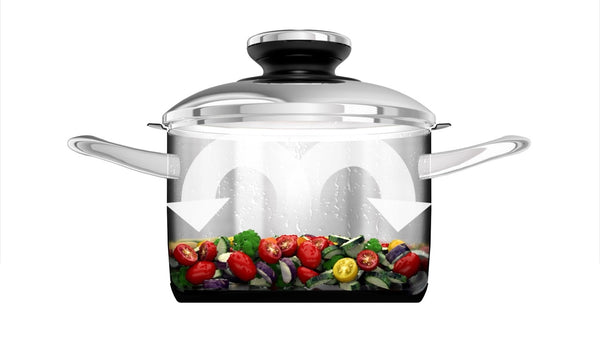
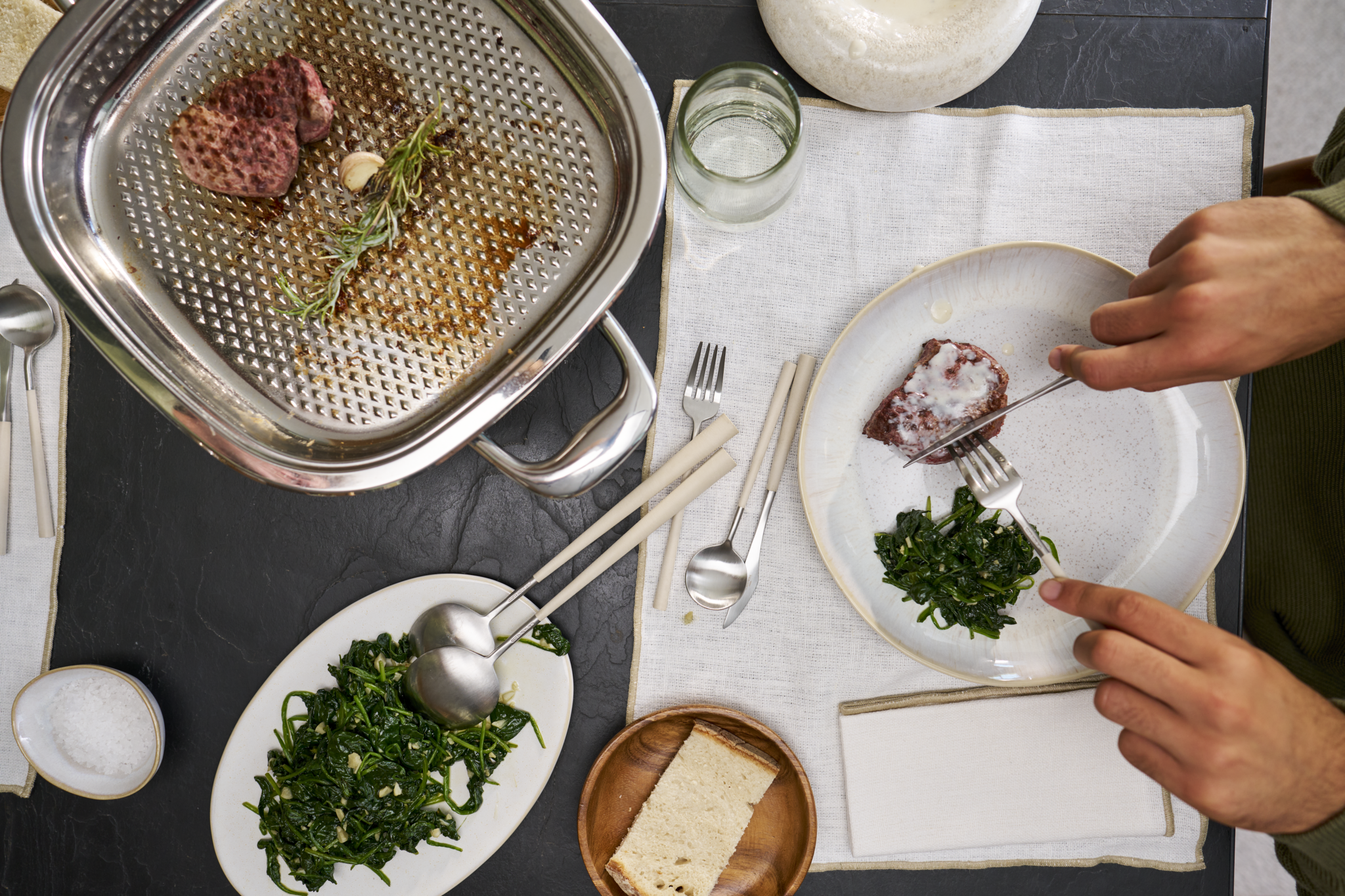
Stainless steel cookware isn't in the same category as the two above, and that's the whole point. There is no coating. The food-contact surface is the metal itself — a corrosion-resistant alloy that doesn't chip, peel, scratch off, or off-gas under any normal cooking condition.
That gives stainless steel three structural advantages no coated pan can match:
- Heat tolerance. Searing, sautéing, broiling, oven use to 500°F+ — all fine. There's no degradation temperature in a kitchen-realistic range.
- Indifference to abuse. Metal utensils, scrubbing pads, dishwashers, decades of daily use. None of it changes what the cooking surface is made of.
- Lifetime ownership. A well-built stainless pan outlasts the kitchen it's used in. Heirloom stainless-steel cookware in regular use after 30, 40, 50 years is unremarkable.
But not all stainless steel is equal — this is the part most articles skip.
What "quality stainless steel" actually means
When you shop, look for these specifics:
- 18/10 food-grade alloy. The numbers refer to chromium and nickel content (18% / 10%), which give the surface its corrosion resistance. 18/8 is acceptable; 18/0 (no nickel) is cheaper and more prone to staining and pitting.
- Multi-ply construction. A single layer of stainless steel conducts heat poorly. The good pans are tri-ply or five-ply — a sandwich of stainless steel on the inside and outside with an aluminum or copper core in between. The core does the heat distribution; the steel keeps it out of your food.
- Encapsulated or full-clad base. Cheap stainless pans put the conductive core only at the bottom (encapsulated). Better pans run the core all the way up the sides (full-clad). Full-clad costs more and cooks more evenly.
- Induction compatibility. A magnet sticking to the base means the bottom layer is magnetic stainless steel, which is required for induction cooktops and a good marker of solid construction.
These specs are what separate a stainless pan you'll use for 30 years from one that warps in the second year.
The comparison, at a glance
|
|
Stainless Steel |
Ceramic-Coated |
Traditional nonstick (PTFE) |
|
Health Profile |
No coating; the food-contact surface is the metal itself |
PTFE-free, but a degradable coating that may expose aluminum or trace metals over time |
PTFE-based; degrades and releases fumes above ~260°C / 500°F; PFAS family |
|
Heat tolerance |
Excellent — high heat, searing, oven-safe to 500°F+ |
Low-to-medium heat only |
Safe under controlled medium heat; risk rises sharply with empty preheating |
|
Durability |
Decades; effectively a buy-once purchase |
1–3 years before coating noticeably degrades |
2–5 years typical |
|
Maintenance |
Dishwasher, metal utensils, scrubbing — all fine |
Hand wash, soft sponges, no metal utensils |
Hand wash, no metal utensils, no high heat, no broiler |
|
Replacement cycle |
Rare to never |
Frequent |
Frequent |
|
Cost over 20 years |
Lower (one set, used continuously) |
Higher (multiple replacement cycles) |
Highest (most frequent replacement) |
|
Legal status (US, 06/2026) |
Unrestricted |
Unrestricted |
Banned with intentionally added PFAS in ME, MN, CO, VT; more states pending |
The "everything sticks" myth
The one real objection to stainless steel is that food sticks. It's also the most misunderstood — because sticking is a technique problem, not a material problem.
A properly preheated stainless pan develops a thin layer of water vapor and oil between the surface and the food. This is called the Leidenfrost effect, and it's why a hot pan with a film of oil releases an egg cleanly while a cold or lukewarm pan welds it on. The technique is simple: add oil to the cold pan, heat the pan for 60–90 seconds and let the oil shimmer (but not smoke), then add food. Don't move it for the first minute — let the surface form, and the food will release on its own.
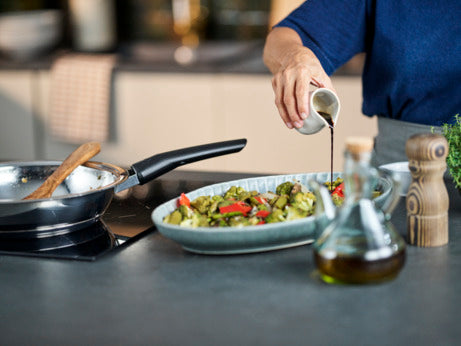
This is the part intelligent-cooking tools help with. A by AMC's Audiotherm device reads pan temperature directly and signals when the surface is at the right point to add food — removing the guesswork that makes stainless steel feel hard at first. After a week of using it, the technique becomes automatic and the pan just works.
Reads pan temperature — no PFAS
 Frying Pan with Lid
$365.00
Frying Pan with Lid
$365.00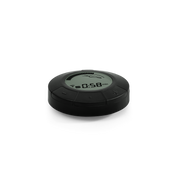 Audiotherm
$125.00
Audiotherm
$125.00
Why we built A by AMC the way we did
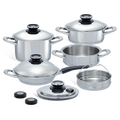
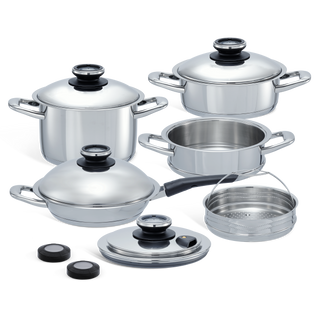
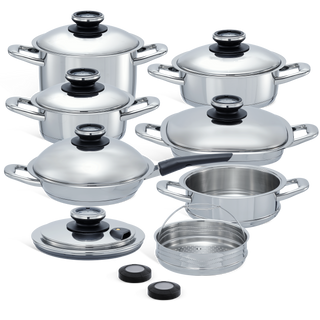
A by AMC cookware uses high-grade stainless steel (18/10 which contains 18% chromium and 8–10% nickel) as the only material that touches your food. No PTFE, no PFOA, no PFAS, no ceramic coatings. Nothing to scratch off, peel, or break down at any temperature your stove can reach.
What we add on top of that base is help with the part most people find hard: getting consistent results without thinking about it. The Audiotherm clips to the pan lid and tracks temperature progress; the Cook & Go app guides the cook through specific dishes step by step. Together they make the longest-lasting cookware you can buy also the easiest to use well.
The pan you don't have to replace is the safest one you can own
Coated cookware has a built-in expiration date. Whether it's a nonstick pan losing its slick at year three or a ceramic pan flaking by year two, you're committing to a replacement cycle — and to whatever the coating releases on its way out.
Solid stainless steel doesn't have that problem. Buy it once, cook on it for decades, pass it down. No coating to monitor, no fumes to worry about, no state bans to track. It's the only cookware category where "non-toxic" is a property of the material itself rather than a claim that has to be defended over time.
That's what to buy.

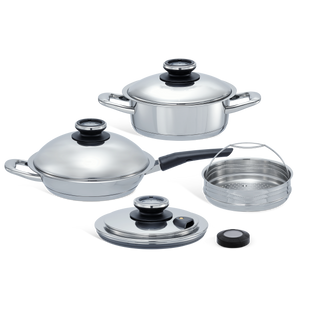
👉 Find the A by AMC system built around the way you cook — browse our cookware sets here.
Buy once. Cook for decades.

Leave a comment
This site is protected by hCaptcha and the hCaptcha Privacy Policy and Terms of Service apply.