



A few years ago, I planned a dinner that needed pork belly first baked, then fried crisp, then finished under the broiler. Three sequential techniques on one cut of meat, because I'd read a recipe that promised it would be transcendent.
It probably was. I wouldn't know. I was in the kitchen the entire evening, lifting things in and out of the oven while my guests finished the starter, then a second round of drinks, then started openly asking each other whether they should order pizza.
I pulled it off. The pork was good. And when the last guest left, I sat down at the wrecked table and felt like a complete failure as a host — because I hadn't actually hosted anything. I'd catered, in my own home, badly.
I didn't host again for almost a year.
What I understand now, and didn't then, is that the problem wasn't the recipe. It was that I'd built the entire evening around a dish that demanded constant supervision — using pans that gave me no margin when anything wobbled.
Effortless hosting is a systems problem, not a skill problem
There's a story we tell ourselves about the people who throw the dinners everyone remembers: they're more talented, more practiced, more something than we are.
They're not. They've just built better systems.
A dinner party that feels easy isn't the result of a more impressive menu or a more confident cook. It's the result of an evening designed so that nothing in the kitchen demands you stay there.
The three things that actually go wrong at dinner parties
Strip away the surface drama of any difficult evening — late guests, conversations that run long, the pan that catches fire — and almost every hosting disaster reduces to one of three failures:
Heat you can't control. The burner is on medium but your pan has a hot spot that's burning the garlic while the onions stay raw.
Timing that won't wait. The main course is ready but the side dish needs another six minutes.
Tools you don't trust. Every dish becomes a small interrogation: Is it done? Is it overdone? Should I check again?
All three are mechanical problems. None of them are about you being a better cook. They're about whether your equipment cooperates or fights you.
What better cookware actually fixes
Quality pots and pans aren't a luxury upgrade in the way a marble countertop is. They're a functional upgrade, like switching from a knife that's gone dull to one that's sharp.
Three things change immediately when the equipment is good:
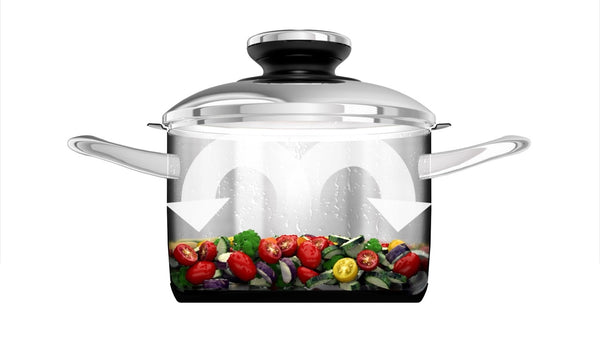
- Heat spreads evenly across the cooking surface.
- Pans hold serving temperature without continuing to cook.
- Cleanup stops eating your evening.
The cumulative effect is that fewer things require your attention, and the things that do require it stay in the window you planned for them.
Why simple food is the move
Here's the part of my pork belly disaster I didn't admit at the time: I picked that recipe because I didn't trust a simpler one to be impressive enough.
When your cookware is unreliable, simple dishes feel risky. So you add complexity as insurance. Each addition multiplies the things that can fail.
The hosts whose evenings actually feel effortless do the opposite. They serve fewer dishes, cooked more reliably.

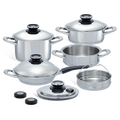
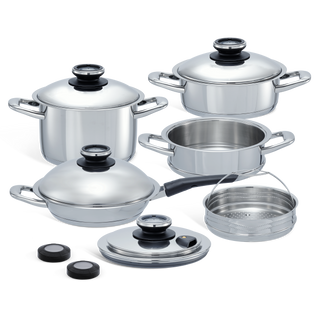
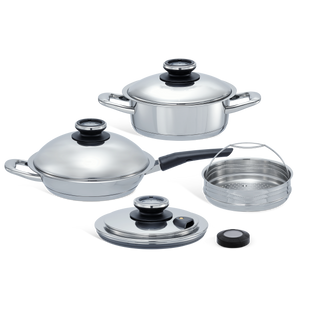
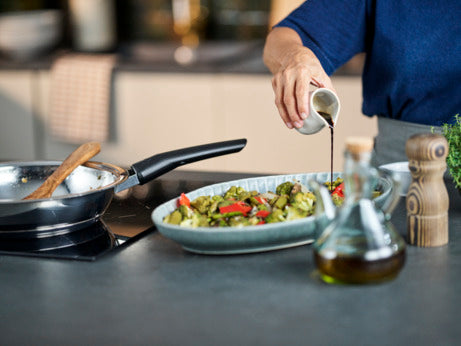
Everyday bundle for fast, smart one-pan cooking with professional results.
This only works when you can trust the equipment to do its job.
You can host or you can cook. Pick one.
The bluntest version of what I learned from the pork belly evening: if your menu requires you to be in the kitchen during the party, it's the wrong menu.
The whole point of hosting at home rather than going to a restaurant is that you're there. You're at the table. You're refilling glasses. You're following a tangent in conversation instead of timing a second sauce.
Better cookware buys you back the evening in a few specific, concrete ways:
- Heavy pans let food rest at temperature, so you can finish dishes ahead and serve them when conversation reaches a natural pause — not when the timer says you must.
- Predictable heat means you can walk away from the stove without panicking that something is burning behind you.
- Oven-to-table pieces — a cast-iron skillet, an enameled Dutch oven, a copper sauté pan with a lid — let you skip the transfer step entirely. The pan becomes the serving dish.
The shift isn't that you cook less. It's that you stop being chained to the burner.
On price, honestly
Premium cookware costs real money. A single serious sauté pan can cost more than an entire starter set at a discount store, and pretending otherwise wastes your time.
Two things make math work.
The first is straightforward durability. A good pan, treated reasonably, will outlast your kitchen.
The second is harder to put a number on but matters more: mental load. That bandwidth is what you're really buying.
A new definition of “great host”
The great host isn't the one with the most ambitious menu. It's the one who's most present at their own table.
Better cookware is one of the smallest changes you can make and one of the few that pays off the first time you use it.
I host regularly again now. I cook simpler food than I used to. People keep coming back.
That's the whole job.
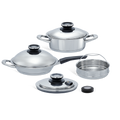
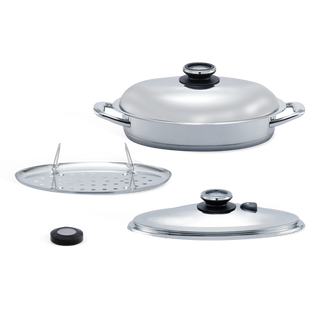
👉 Two of our most-loved sets for home hosts: the Convio and the Foundation Collection.
Sets for entertaining
Our top picks
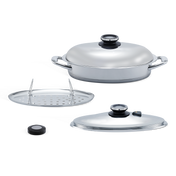 Convio
$945.00
Convio
$945.00
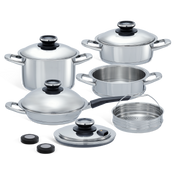 Foundation Collection
$1,585.00
Foundation Collection
$1,585.00

Leave a comment
This site is protected by hCaptcha and the hCaptcha Privacy Policy and Terms of Service apply.