



Healthy Cooking
Cooking with Minimal Water Explained: How to Preserve More Nutrients, Color and Flavor
What minimal water cooking actually is, why it retains more vitamins and flavor than conventional cooking methods, which foods respond best, and the cookware that makes it work.

You bought the broccoli fresh, maybe even organic, because you know it matters. Then you put it in a pot of boiling water and poured that water down the drain.
A lot of the nutrition went with it.
That is not an exaggeration. Vitamins like C and B dissolve into cooking water. The longer your vegetables sit submerged, the more those nutrients leach out into the liquid you discard. It happens every time you boil.
Cooking with minimal water works differently. The food cooks in its own natural moisture, sealed inside a closed pot. There is no cooking liquid for nutrients to dissolve into, so more of them stay in the food, along with more of the flavor and color.
Here is how minimal water cooking works, what it preserves, and what you need to do it right.
What is Cooking with Minimal Water?
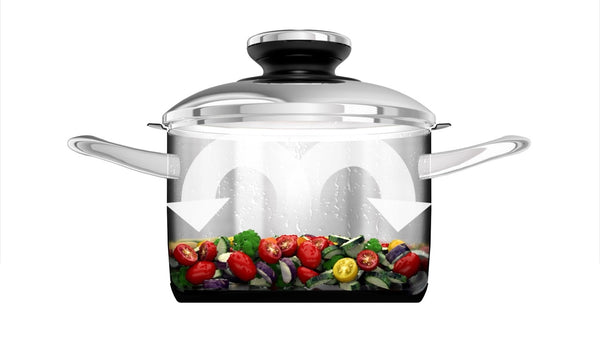
The minimal water cooking method is exactly what the name describes. Instead of submerging food in boiling water, you place rinsed food still dripping wet directly in a closed pot and apply gentle heat. The natural moisture already in the food heats up, turns to steam inside that closed environment, and circulates around it. The food cooks in its own vapor, at a lower temperature than boiling ever reaches.
No added water. No cooking liquid to discard.
What you notice when you cook this way
When you open the lid at the end, you see condensation beaded on the underside. That moisture came from the food itself, not from any water you added. It has been circulating as gentle steam, cooking everything from all sides at once.
The result is vegetables that look and taste the way they should. Broccoli holds its deep green. Carrots stay bright. Nothing goes gray or limp. That color difference is not just visual. When broccoli shifts from bright green to dull gray-green, chlorophyll is breaking down under heat and water exposure. Vibrant color is a good sign that more survived the cooking process, including the nutrients.
How this differs from conventional steaming
Minimal water cooking is sometimes confused with steaming, but the two methods work differently.
Conventional steaming lifts food above simmering water in a basket, covers the pot with a lid, and uses the steam rising from that water to cook the food. It is gentler than boiling because the food never sits in liquid. But it still depends on added water as its steam source. And the lid seal matters just as much for steaming as it does for cooking with minimal water. A loose-fitting lid lets steam escape and makes the results inconsistent.
Cooking with minimal water uses the food's own moisture. Rinsing vegetables and placing them in the pot still wet is all the water the method needs. A properly closed lid traps that moisture from the moment you close the pot. That is where cookware quality makes a real difference. Most standard pot lids do not fit precisely enough to maintain that seal consistently, which is one reason minimal water cooking is harder to replicate reliably with ordinary cookware than it sounds.
How Cooking with Minimal Water Preserves Nutrients, Color and Flavor
Most people know vegetables are good for them. Fewer realize how much of that goodness can disappear before the food even reaches the plate. The cooking method is the variable most home cooks never think to question.
Why boiling works against you
Not all vitamins behave the same way around water. Fat-soluble vitamins, including A, D, E and K, do not dissolve in liquid, so boiling does not strip them from food the way it strips others. They ride out the cooking process relatively intact.
Water-soluble vitamins are a different story. Vitamin C and the B vitamins are found in high concentrations of everyday vegetables like broccoli, spinach and cauliflower. They dissolve readily in liquid. Put those vegetables in a pot of boiling water and those vitamins start moving out of the food and into the water around them. The longer they sit, the more is lost. Drain the pot and you discard them.
The key variable is not the heat. It is whether the food has liquid to leach into.
What changes when you cook with minimal water
Minimize the water and you minimize the problem. When food cooks in its own sealed moisture, the water-soluble vitamins have far less opportunity to leach out, so more of them stay in the food.
That finding is reinforced by independent peer-reviewed research. A study in Food Science and Biotechnology found that Vitamin C retention from boiling ranged from less than 1% to under 74% depending on the vegetable, with boiling consistently producing the lowest retention of any method tested.
Reducing water contact during cooking is the most reliable way to improve nutrient retention in food. A closed cooking environment is what makes that possible, and it is something standard cookware cannot consistently deliver. It is also what separates purpose-built minimal water cookware from an ordinary pot with a lid.For a deeper look at how cooking methods affect nutrition, see healthy cooking at home
What cooking with minimal water does to flavor and color
Nutrients are not the only thing that leaves food when you boil it. Flavor does too.
The aromas and volatile compounds that give vegetables their taste are sensitive to heat and evaporation. In an open pot, they cook off into the air. In a sealed environment, they have nowhere to go, so they stay in the food. The result is vegetables that taste more like themselves, without the watery, muted flavor that comes from cooking in a pot of water.
Color follows the same principle. The pigments that give vegetables their brightness break down with prolonged heat and water exposure. Less of both means more survives. The vibrant color you see when you open the lid is not just more appealing. It is a reliable sign that the cooking environment protected what was inside.
What Foods Work Best for Minimal Water Cooking

Most of the vegetables you already buy at the grocery store work well when cooking with minimal water. Starting with the right ones makes the difference most noticeable.
High-Moisture Vegetables
Broccoli, cauliflower, green beans, spinach, peas, corn and cabbage all have enough natural moisture to cook entirely in their own steam. These are also the vegetables where the difference between minimal water cooking and boiling is most apparent.
The color is brighter, and less of what makes these vegetables nutritious and flavorful ends up in the water you pour down the drain.
Dense Root Vegetables
Carrots, potatoes, squash and turnips work well with the minimal water cooking method too. Because they are denser, they take a little longer and do better cut into smaller pieces so the heat and moisture can move through them evenly.
Frozen Vegetables
Frozen vegetables work just as well as fresh. The natural water content inside the vegetable is what drives the method, and freezing does not change that. Cook them straight from frozen the same way you would fresh.
Of course, weeknight cooking is rarely just vegetables. Searing a piece of chicken, roasting without oil, steaming fish. Those are part of the same kitchen. The cookware that handles this method well tends to handle all of it well, and the reasons why are worth understanding.
The Best Cookware for Cooking with Minimal Water

Not every pot can accomplish cooking with minimal water. Choosing the right minimal water cookware is what determines whether the method actually works, because it puts three specific demands on the pot that most standard options cannot consistently meet.
Three things cooking with minimal water requires
Good cookware needs to do three things well to make cooking with minimal water work reliably:
- A lid that closes properly. The closed environment is everything. If steam escapes around the rim, the moisture the food depends on disappears, the cooking temperature falls, and the vegetables either dry out, cook unevenly or even burn. A lid that rests loosely on the pot is not enough.
- Even heat across the full base. Cooking with minimal water has minimal liquid inside to absorb and balance heat. If the base concentrates heat over the burner, the food directly above it overcooks while everything else falls behind. A flat, consistent cooking temperature across the entire surface keeps the method working from edge to edge.
- Temperature visibility. The right cooking zone for cooking with minimal water is below boiling. Knowing when you are there, and staying there, is what keeps nutrients and moisture in the food. If the only way to check the temperature is to lift the lid, the sealed environment is broken every time.
How A by AMC is designed for cooking with minimal water
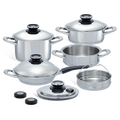
A by AMC is an active cookware line with 60 years of Swiss engineering behind it. Every piece is built from 18/10 stainless steel with no coatings, no PFAS, no PTFE, and a 30-year warranty. What makes A by AMC different from standard stainless cookware is that the system tells you what is happening inside the pot while the lid is still on.
Each of those three requirements is built directly into A by AMC's cookware.
- Consistent heat distribution: Every A by AMC pot is built on a multi-layer, pressure-welded base called Akkutherm. It absorbs heat from any stovetop and spreads it evenly across the full cooking surface, eliminating hot spots. It also holds heat after the setting is reduced, keeping the cooking environment stable without constant high heat. The handles work on a separate technology, Thermobloc, engineered to block heat rather than distribute it, so they stay cool throughout.
- A reliable “seal”: The high-dome lid that comes with every A by AMC collection fits precisely against the rim, so less moisture, fewer nutrients, and less flavor escape than they would through a loose-fitting lid.
- Temperature feedback: A precision sensor built into the lid reads the actual temperature inside the closed pot and displays it in real time on the lid knob. A dedicated zone on that display shows when you have reached the right point for cooking with minimal water. No need to open the lid or guess. Pair it with the Audiotherm, an acoustic cooking assistant that clips onto the lid, and you do not even need to watch the display. It signals you when something needs attention.
For a full breakdown of how the system works across every cooking method, see how A by AMC's cooking system works
How A by AMC compares to other cookware
Premium stainless steel cookware brands offer quality metal and a strong track record. What they do not offer is any visibility into what is happening inside the pot while you cook. No built-in sensors, no temperature display, no signal to act. For cooking with minimal water, that means relying on guesswork or breaking the sealed environment to check.
Coated cookware, including non-stick and ceramic pans, raises a different question. Coatings wear down and raise concerns about what ends up in food over time. A by AMC has no coatings. The stainless steel is the cooking surface and it does not change.
Cooking with minimal water rewards precision. The sensor-led ecosystem built into A by AMC is what delivers it.
Which A by AMC Collection Is Right for You

Every A by AMC collection supports cooking with minimal water. Every pot and lid is built for it, powered by responsive sensor-led technology that makes every other cooking method just as reliable. Beyond minimal water cooking, A by AMC also handles steaming, searing and roasting without adding oil or fat.
Which collection to start with
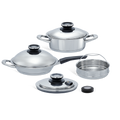
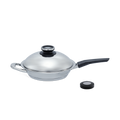
The Essential Collection is where most people begin. It includes a Rondeau for minimal water cooking, an EasyQuick steaming lid and Softiera basket for steaming, a Frying Pan for searing and roasting without added fat, and an Audiotherm. Cooking with minimal water, steaming and no-added-fat searing are all there.
Explore the Essential Collection
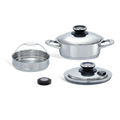
Pure Steam+ is built for cooks whose focus is cooking with minimal water and steaming, and who do not need a frying pan in the set. It includes the Rondeau, the EasyQuick lid, the Softiera basket, the Combi insert for multi-level steaming, and an Audiotherm. It is a focused setup for cooks who want to go deep on these methods.
Explore Pure Steam+
Not sure which fits how you cook? Take the 2-minute quiz for a personalized recommendation.
Frequently Asked Questions
What is cooking with minimal water?
Cooking with minimal water is a method where food is placed directly in a tightly sealed pot and cooked using its own natural moisture. The heat causes that moisture to turn to steam inside the sealed environment, which circulates around the food and cooks it from all sides. No water is added. No liquid is drained off at the end. Because there is no cooking liquid for water-soluble vitamins to dissolve into, more of them tend to stay in the food than with conventional methods that submerge food in water.
Does cooking with minimal water retain more nutrients than steaming?
Both methods outperform boiling because neither submerges food in water. Cooking with minimal water takes it a step further. Steaming still uses added water below the food as its steam source. Minimal water cooking uses very little water. The food generates its own moisture, and the closed lid keeps it inside, leaving far less for the vitamins to dissolve into.
Do you need special equipment for cooking with minimal water?
Yes, but the equipment is the pot itself, not a separate add-on. The right cookware for cooking with minimal water needs three things: a tight lid “seal”, even heat across the base, and a way to monitor the cooking temperature without opening the lid. A by AMC’s is built to do all three. Every collection includes what you need to cook this way.
What foods work best for minimal water cooking?
Most everyday vegetables respond well. Broccoli, cauliflower, spinach, green beans, peas and corn all have enough natural moisture to cook entirely in their own steam. Root vegetables like carrots and potatoes work too, though they take a little longer. Frozen vegetables work just as well as fresh.
Cook. Respond. Succeed.
A new way of cooking. Built to last. Made to repeat.
Explore the A by AMC active cookware line and find the ecosystem built for the way you cook.