



Buying Guides · Pillar
The Ultimate Premium Cookware Buying Guide: What to Look for in Cookware That Lasts
What actually separates premium cookware from everything else on the shelf, the materials and construction that hold up over time, and how to find the right starting point for your kitchen.

There is a moment every serious home cook arrives at. The non-stick pan that worked beautifully eighteen months ago now sticks at the edges. The handle feels loose. The coating has gone dull in patches. You reach for it anyway, because replacing it means starting the same cycle again.
This cookware buying guide is for cooks who are done with that cycle. Premium cookware isn't defined by a price tag or a brand name. It's defined by engineering, and by the end of this guide you'll know how to spot it. Then you'll know exactly which collection fits the way you actually cook.
What Makes Cookware Genuinely Premium?

A pan might cost $40 or $400, but both will heat food. The real question is: what are you actually paying for when you invest more in cookware?
Premium cookware is an engineering specification. The word appears on pans at every price point, which makes it close to meaningless on its own. What separates cookware worth the investment from cookware that is not, comes down to three things.
- Base Engineering: Heat must travel from the burner through the base and distribute evenly across the cooking surface. A pan that does this well produces consistent results. One that does not, creates hot spots, areas that scorch while the rest of the surface stays cooler. Hot spots are not a cooking problem. They are an engineering problem, and no technique corrects them.
- Build Integrity Over Time: A pan that warps after just a year of use has failed as a product, regardless of its initial cost. Proprietary cladding that resists warping, lids that seal properly, and handles that stay secure through years of washing and heat cycling are what signify quality construction that lasts.
- How It Performs Day to Day: The best cookware does not just survive a stress test, it earns a place in daily rotation. Balance in the hand, a weight that feels secure when full, and consistency that does not require the cook to relearn the pan every time heat or ingredients change are what make a piece practical, not just impressive.
Getting all three right is what actually separates the best stainless steel cookware brands from the rest of the shelf.
Among premium cookware brands, A by AMC provides all three of these elements and is built on 60+ years of engineering and 180+ years of family heritage, combining Swiss precision and Italian craftsmanship.
On top of that foundation, A by AMC adds a responsive sensor-led ecosystem: a base that reads the heat, a lid that displays it in real time, and a signal that tells the cook exactly when to act, instead of leaving any of that to instinct.
Materials: Stainless Steel, Non-Stick, Ceramic, and Cast Iron
Not all cookware is made the same way, and the material determines almost everything else: how it performs, how long it lasts, and what it puts into your food.
Here is an honest comparison of the four main categories a home cook will encounter when shopping for the best cookware set.
Stainless Steel
Is stainless steel the best cookware material available? For most cooks, yes, and the reason is simple: unlike non-stick and ceramic cookware, 18/10 premium stainless steel cookware has no coating between the metal and your food. Key characteristics include:
- Corrosion Resistance: The chromium in the alloy forms a passive oxide layer to prevent corrosion and chemical reactions with acidic ingredients.
- High Heat Tolerance: Handles high heat without degrading, allowing for seamless transitions from stovetop to oven.
- Durability: Survives dishwashers, metal utensils, and decades of use without losing its properties.
The term "18/10" refers to the specific chromium and nickel content of the stainless steel alloy:
- 18% Chromium: Creates a passive oxide layer that grants corrosion resistance and prevents reactions with food.
- 10% Nickel: Adds durability, imparts a characteristic polish, and enhances resistance to mechanical wear over time.
In contrast, 18/0 stainless steel, commonly found in budget cookware, lacks nickel content. While it is harder and more magnetic (a characteristic that can make it suitable for induction-compatible pans), it is also more brittle and less corrosion-resistant than 18/10. When a pan description does not specify the grade, that is worth noting.
The one objection to stainless is that food sticks. This is a technique issue, not a material issue.
A properly preheated stainless pan with a film of oil releases food cleanly. The Leidenfrost effect (the thin vapor layer that forms between a hot surface and food) is what makes this work. The technique becomes automatic within a few sessions. After that, stainless is the least demanding material in the kitchen.
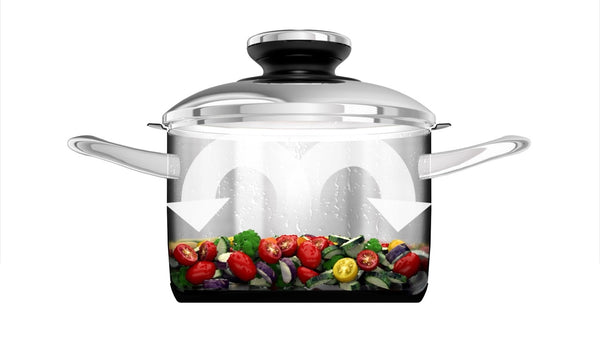
That open-pan technique is what searing and frying require. Once the lid goes on, the math changes. A by AMC's high-dome lid creates a closed cooking environment that allows cooking with less added water and oil while preserving more nutrients, color, and flavor, the same principle covered in full in our guide to healthy cooking at home. None of it depends on a non-stick coating to make it work.
As a reflection of our commitment to wellness and product integrity, all A by AMC cookware is manufactured without non-stick coatings or toxic chemicals that could contaminate food. All A by AMC products are free from:
- PFAS, PFOA, and PTFE-free
- Lead, phthalates, cadmium, mercury, and antimony
- Hard anodization
For more information, see our complete guide to non-toxic cookware.
Non-Stick (PTFE)
Non-stick cookware coated with PTFE, originally marketed as Teflon, is widely used in American kitchens due to its convenient features:
- Easy Food Release: Food slides off effortlessly.
- Quick Cleanup: Fast and efficient washing.
- Low-Heat Cooking: Functions well at lower temperatures without special techniques.
The tradeoffs are just as straightforward. PTFE coatings begin to degrade at around 260 degrees Celsius (500 degrees Fahrenheit), a temperature an empty pan can reach quickly on a high gas burner. Once degradation starts, the coating releases ultrafine particles and gaseous fluorocarbons.
Beyond the chemistry, non-stick coatings wear down with regular use. Metal utensils, dishwasher cycles, and high heat all shorten how long the coating performs well. Replacing a worn non-stick pan is not a one-time event. It is a recurring cost built into the choice.
Ceramic
Ceramic cookware is widely marketed as the safe alternative to PTFE. The "ceramic" label refers to a thin sol-gel or silica-based coating applied to an aluminum pan body, not to the material of the pan itself. That coating is PTFE-free and PFOA-free. It is also fragile.
High heat, metal utensils, abrasive cleaning, and dishwasher cycles all degrade the ceramic surface, often well before the rest of the pan wears out. Once the coating degrades, the aluminum body underneath is exposed to food. Some lower-quality ceramic coatings have been documented to release trace heavy metals including lead and cadmium as the coating breaks down.
Ceramic is better than PTFE on the chemical profile. It is still a coating that degrades, and still a pan that will need replacing.
Cast Iron
Cast iron is one of the most durable cooking surfaces available. A well-maintained cast iron pan will last multiple generations and produces excellent results for high-heat applications including searing and pan roasting, a steak with a deep, hard crust or a skillet of cornbread with a crisp bottom are both better on cast iron than almost anything else in the kitchen.
The tradeoffs are real. Cast iron is heavy, slow to heat, and requires seasoning to maintain its cooking surface. It is not induction-compatible in all configurations, reacts with acidic foods if unseasoned (a tomato sauce simmered too long can pick up a metallic taste), and cannot go in the dishwasher.
For a cook who wants a single pan that does everything well, cast iron is not that pan. It excels in specific techniques and is a poor choice as the core of a kitchen system.
Stainless Steel Construction and Compatibility: What the Specs Actually Mean

Once you understand why 18/10 stainless is the material standard, the next question is how that metal gets built into a pan, and what it can handle once it's in your kitchen.
Capsule Base vs. Fully Clad Construction
There are two primary approaches to achieving effective heat distribution in stainless cookware, and both come down to ply count: the number of metal layers bonded together.
- Fully Clad Construction: This technique bonds multiple metal layers, often three (tri-ply) or five (5-ply), with a conductive core such as aluminum sandwiched between layers of stainless steel that extend up the sides of the pan, not just the base. The aluminum quickly conducts heat and spreads it evenly across the entire cooking surface, including the sides of the pan.
- Capsule Base Construction: In this method, those layers are concentrated at the base of the pan only, where the heat source directly contacts the metal, rather than extending up the sides. A by AMC’s Akkutherm capsule base is a multi-layer, pressure-welded capsule that:
- Absorbs heat rapidly
- Distributes it evenly across the cooking surface
- Stores residual heat once the burner is reduced
This design eliminates hot spots, ensures consistent cooking results, and maintains temperature without overcooking the food inside. Thermobloc, a distinct cool-touch handle technology, keeps the handles comfortable to hold no matter how hot the base gets.
Akkutherm is one of five core technologies built into A by AMC's sensor-led ecosystem. Sensotherm measures the temperature inside the cooking chamber, Visiotherm displays it on the lid in real time, Audiotherm signals the exact moment to act, and the Cook & Go App connects to the Audiotherm over Bluetooth so the cook can step away from the stove. Together, they turn what is happening inside the pan into something you can see, hear, and act on.
Induction, Oven, and Dishwasher Compatibility
All A by AMC cookware works on gas, electric, ceramic, and induction stovetops, which matters if you're searching for the best stainless steel induction cookware specifically. The Akkutherm base contains the magnetic properties required for induction compatibility.
- Oven-safe: remove the Audiotherm, Visiotherm, and frying pan handle before use in the oven
- Dishwasher-safe, with one exception: the Audiotherm contains a battery, only use a damp cloth to clean it.
For a full breakdown of how this construction stacks up against the leading traditional premium brand, see A by AMC vs. All-Clad: Full System Comparison for Serious Home Cooks.
The True Cost of Ownership
The most common objection to the best stainless steel cookware is the price. Before making that judgment, it is worth looking at what the alternative actually costs over time.
- Entry-Level Non-Stick Cookware: A typical set ranges from $80 to $150. These are the pans most American households purchase from department stores and major retailers.
- Longevity Concerns: Under regular use, non-stick coatings wear down over time, and most sets need replacing well before the rest of the kitchen does.
- Long-Term Costs: Replace a non-stick set every few years over a decade, and the cost adds up. Stretch that out over 30 years (the length of A by AMC's warranty on stainless steel) and the replacement cycle alone can cost more than a premium stainless set that never needs replacing. That is before accounting for price increases over time, upgrades to premium sets mid-cycle, or the mental overhead of managing cookware that is always partially degraded.
A by AMC's stainless steel body carries a 30-year warranty for US purchasers. The warranty covers the stainless steel construction, is not transferable, and reflects a straightforward engineering commitment: the metal is built to last. "Buy once. Use for generations."
The Kitchen Innovation Award in 2021 recognized the A by AMC cooking system, including a Best of the Best distinction in the Small Electrical Appliances category, and the Cook & Go App received the same recognition in 2023.
Cookware that does not need replacing means:
- Less manufacturing
- Less packaging
- Less waste
That is the honest environmental argument for buying premium. Fewer pans over a lifetime.
For a complete breakdown of the cost of ownership, including a detailed comparison between cheap and premium cookware over a 10-year horizon, see our guide to the true cost of cheap vs. premium cookware.
For a closer look at how better cookware changes your evening as a host, read The Dinner I Cooked Three Ways and Barely Survived.
Building Your Kitchen Around One Ecosystem

Most cooks build a kitchen the same way: one pan at a time, replacing what breaks, adding what seems useful. The result is a drawer of mismatched lids and a cabinet of pans that were each bought for a specific reason and now share nothing in common.
A by AMC is designed around the opposite logic, and you notice the difference with more than your eyes. The temperature climbing on the lid replaces the guesswork of lifting it. The Audiotherm calls you back instead of asking you to hover at the stove. The handle stays cool to the touch, and a closed cooking environment that needs less added water and oil means more of the ingredient's own flavor stays in the food.
Here is how A by AMC’s core technologies work together:
- Sensotherm reads the actual temperature inside the cooking chamber, not the stove setting or the outside of the pan.
- Visiotherm displays that reading on the lid in real time, so you can see what's happening without lifting it.
- Audiotherm clips onto the lid and signals the exact moment to act, connecting via Bluetooth to the Cook & Go App so you can step away from the stove.
Together, they make the results repeatable. The system tells the cook what's happening instead of leaving it to guesswork.
A by AMC collections bundle the cookware, lids, and Audiotherm together, so everything works as one system from the start. Building a kitchen one piece at a time works too, individual pieces, including pots, pans, lids, and the Audiotherm, are sold separately on the A by AMC shop for cooks who want to expand an existing kitchen rather than start fresh.
Every pot and pan in a collection works with the same Audiotherm, so each additional piece adds another use for a tool you already own rather than requiring a new one.
How to Choose the Right A by AMC Collection
Once you know what to look for, choosing the best stainless steel cookware set for your kitchen comes down to matching a collection to how you actually cook. Four collections are available.
Each one is a complete starting point built around a different cooking life, not a starter kit that requires immediate additions.
Essential Collection

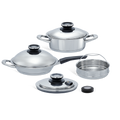
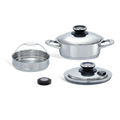
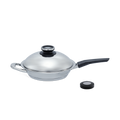
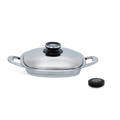
Built for the first-time owner, the single-cook household, and the light entertainer. The Frying Pan and Rondeau handle searing and roasting with no added fat, while the EasyQuick lid and Softiera basket turn either pot into a steamer. All three lids have Sensotherm built in. This set includes one Audiotherm to be used interchangeably.
Essential+ Collection

Essential+ includes everything in the Essential Collection, plus the Combi sieve, which adds a second steaming level inside the pot for stack cooking: two foods steaming at once under one EasyQuick lid.
Foundation Collection

Step up from Essential+ with the Stock Pot and a second Audiotherm. The Stock Pot adds capacity for soups, stews, and batch cooking, and the second Audiotherm lets you monitor two pots at once. Built for the active cook in a 2 to 4 person household who cooks most nights of the week.
Foundation+ Collection

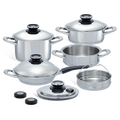
Foundation+ includes everything in Foundation, plus a Grill Pan and a dedicated Saucepan. The Grill Pan handles high-heat searing and grilling, and the Saucepan covers smaller dishes and side sauces. Built for the family of four or more, and the household that entertains. It is the last cookware set most cooks will ever need.
Still not sure which one fits? Take our 2-minute quiz for a personalized recommendation. Or compare the details below.
See current pricing and full collection contents on the A by AMC cooking systems page or compare bundle savings across collections.
The 30-year warranty on A by AMC stainless steel applies to all four collections. Read what the warranty covers and how to make a claim.
Frequently Asked Questions
What is the best stainless steel cookware?
The best stainless steel cookware distributes heat evenly, does not react with food, and endures years of regular use without degrading. The construction standard that defines premium stainless steel cookware is 18/10 stainless steel with a multi-layer pressure-welded base. A by AMC's cookware meets this standard, enhanced with a responsive sensor-led ecosystem for repeatable cooking results.
Is stainless steel or non-stick cookware better?
Non-stick wins on first-use ease. Food releases without technique, cleanup is fast, and it works at low heat. Stainless steel wins on longevity, safety profile, and cooking range. Non-stick coatings wear down over time and need replacing. 18/10 stainless does not. For a cook who wants cookware that lasts and performs across every method, stainless is the better long-term choice.
What does 18/10 stainless steel mean?
The term "18/10" refers to the alloy composition of the steel:
- 18% Chromium: Creates a passive oxide layer that prevents corrosion and reactions with acidic foods.
- 10% Nickel: Adds durability and provides a polished finish.
18/10 is the grade that tells you a pan will not rust, will not leach into food, and will not need replacing.
Is premium cookware worth the money?
Yes, especially over time. A non-stick set needs replacing well before a premium stainless set does, and that replacement cycle adds up over the years. A by AMC backs its premium stainless steel cookware with a 30-year warranty, making the upfront cost worthwhile compared to long-term spend.
How long should a good cookware set last?
Quality 18/10 stainless steel cookware, which has no degrading coatings, should last for decades. A by AMC warranties its stainless steel body for 30 years. With reasonable care, this cookware will often outlast the kitchen it is used in.
What cookware do professional chefs use at home?
Stainless steel is a standard choice in professional kitchens for stovetop cooking. It handles high heat, develops fond for pan sauces, does not react with acidic ingredients, and gives the cook full control over the result. Chefs use it not because it is the easiest material but because it is the most responsive.
For cooks who want that same responsiveness, with a system that monitors the temperature and signals when to act, stainless steel and A by AMC's sensor-led ecosystem are the combination that makes professional results repeatable at home.
For a closer look at exactly where that line falls for your kitchen, see how much should you spend on cookware.
Cook. Respond. Succeed.
A new way of cooking. Built to last. Made to repeat.
Explore the A by AMC active cookware line and find the ecosystem built for the way you cook.