



Buying Guides
How Much Should You Spend on Cookware? The True Cost of Cheap vs. Premium
What really separates cheap cookware from premium, how the two compare both on the stove and over the years, and how much you actually need to spend on a set that holds up.

You have probably done this at least once. A cookware set catches your eye for under a hundred dollars, the low price feels like a win, and into the cart it goes. Two or three years later the coating is scratched, food sticks where it never used to, and you are back online shopping for another set.
But replacing it is only half the cost. The other half is how it cooks the whole time you own it. Thin, cheap bases put too much heat in the center and leave the edges cool, so food sticks and burns in spots. Cheap cookware costs you two ways. It cooks worse every time you use it, and it wears out every few years.
So how much should you spend on cookware? The useful answer starts somewhere else. Not with what a set costs today, but with what it costs you every time you cook on it, and every few years when you replace it.
Is Cheap Cookware Actually Cheaper?
Cheap cookware and expensive cookware will both cook dinner tonight. The difference shows up in how well they cook it and how long they last.
Cookware sorts roughly into three price ranges:
- Budget sets: around $50 to $150
- Mid-range sets: about $150 to $400
- Premium sets: $400 and up
Price alone does not tell you much, though. A budget non-stick set and a bare stainless steel set can sit at the same price but will not last as long, because the first thing to fail is almost never the metal. It is the coating on top of it.
In the end, you are not really choosing a price. You are choosing how often you will be replacing it. Price is only one piece of the decision, and our full premium cookware buying guide covers the rest, from materials and construction to matching a set to how you cook.
What Cheap Cookware Really Costs You
The price on the box is only the start. What cheap cookware actually costs you shows up in two places, at the stove and at the register.
Cheap pans cook worse
Thin, cheap pans do not spread heat evenly. The center runs hot while the edges stay cool, so one part of the food scorches while another barely browns. Thin bases also warp under high heat, and a warped pan rocks on the burner, making the hot and cold spots worse. That is not a technique problem you can cook around. It comes with the pan, and you pay for it every time you use it, in food that sticks, burns, or cooks unevenly.
Then the coating gives out
Cheap pans are almost always non-stick, a thin layer of PTFE or ceramic coating over an aluminum body. The coating is what makes food slide, and it is the part that fails first. Most cheap non-stick pans wear out within a few years, as the coating starts to go and food begins to stick. Metal utensils, high heat, and the dishwasher wear it down faster. When the surface starts peeling, or food sticks no matter what you do, the pan is finished. The metal underneath may look fine, but the part you were paying for is gone. That means you do not buy the pan once. You buy it again every few years.
The ten-year math
Add those replacements up over ten or twenty years and the math tips the other way. Here is how the two compare over time.
| Budget non-stick | Quality stainless steel | |
|---|---|---|
| Typical upfront cost | $50 to $150 per set | $300 to $700+ per set |
| Cooking surface | PTFE or ceramic coating over aluminum | Bare 18/10 stainless steel, no coating |
| Realistic lifespan | About 2 to 5 years before the coating fails | Decades, often outliving the kitchen |
| Replacements over 30 years | Several sets | Potentially none |
| What you are left with | A recurring cost, plus old pans in landfill | One purchase, backed by a warranty |
Figures are general current-market ranges, not A by AMC prices.
Play that out over time. A budget set gets replaced every few years, so you buy cookware three, four, even five times across a couple of decades. Add it up and you have spent more than a single quality stainless set costs, and you are still replacing pans. The stainless set is still in the drawer, performing the same as the day you bought it.
Every cheap pan ends up in a landfill
There is one more cost, and the planet pays it. A worn-out non-stick pan is hard to break down, because the coating has to be stripped off the metal first, so almost none of it ever gets recycled. It goes in the trash, then the landfill, and it stays there. Buy a cheap set every few years for a couple of decades and that is a small stack of dead pans with your name on it. Buy once and you throw almost none of it away. Fewer pans made, fewer pans hauled off, less waste all around.
What You're Actually Paying For at the Higher End

When you move up into premium cookware, you are not paying for a fancier coating. You are paying to take the coating out of the equation, and at the very top of the market, for a system that does more than hold heat.
What 18/10 stainless steel cookware actually is
The best stainless steel cookware is made from 18/10 stainless steel. When people shop for 18/10 stainless steel cookware, those two numbers are what they are really asking about and here is what they mean:
- 18% chromium, which forms a passive layer that resists rust and keeps the metal from reacting with acidic food
- 10% nickel, which adds strength and gives the steel its bright, durable finish
You will also see 18/0 and 18/8 grades, which contain less nickel or none at all. They cost less and are more prone to corrosion and wear over time. 18/10 is the top grade. It resists rust, does not react with food, and has no coating that can wear off. The steel itself is the cooking surface.
The one knock on stainless is that food sticks to it. That is a technique thing, not a flaw in the metal. Heat the empty pan until a drop of water beads and skates across the surface, add a little oil, then add your food. Give it a moment and it releases on its own. After a few tries it is second nature.
What you get in return is durable cookware that takes high heat, moves from the stovetop to the oven, survives the dishwasher, and lasts for decades. And because there is no coating anywhere on it, quality 18/10 skips the health questions that come with worn non-stick. We cover which materials are safe and which to avoid in our non-toxic cookware guide.
Where A by AMC fits, and why it costs more than other stainless
Here is the honest part. Good 18/10 gets you durability, but on its own it does not get you A by AMC. All-Clad and most other premium stainless brands use the same grade of steel, so the metal is the starting point they all share, not the thing that separates them. Judged on the steel alone, a mid-priced quality stainless set lasts about as long as a much pricier one. We put the two brands head-to-head on exactly that in our A by AMC and All-Clad comparison.
A by AMC starts from that same premium foundation. The brand brings 60+ years of engineering and 180+ years of family heritage, Swiss precision joined with Italian craftsmanship, and builds every piece from 18/10 stainless steel with no coatings, no PFAS, and no PTFE.
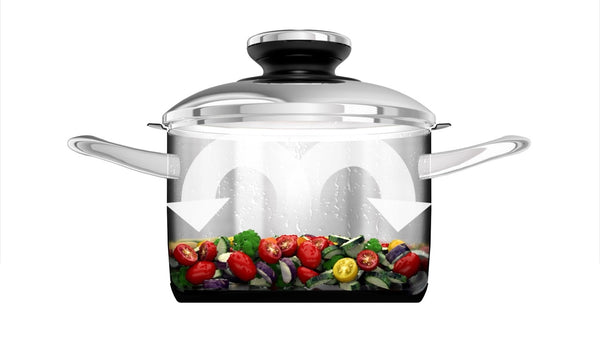
Beyond the metal comes a responsive sensor-led ecosystem. A by AMC cookware reads the real heat inside the closed pot, shows it on the lid, and signals the cook when to act, so you are cooking on real information instead of guesswork. The payoff is repeatable results, something neither cheap cookware nor other premium stainless can give you. The full mechanics are in our breakdown of how A by AMC's cooking system works.
What a 30-Year Warranty Actually Covers

Price tells you what cookware costs. A warranty tells you what the maker actually believes about how long it will last. A brand does not put a 30-year guarantee on something it expects to replace.
What is covered
A by AMC backs the stainless steel body of its cookware with a 30-year warranty for US purchasers. That covers the stainless steel construction itself, the part that does the cooking and takes the wear. That is a plain statement about the metal. It is made to hold up for decades of regular use.
Why the warranty runs 30 years
A 30-year warranty is not just paperwork. A brand does not guarantee cookware for thirty years unless it expects that cookware to still be in use three decades later. Cheap pans rarely come with a warranty worth much, because the coating was never going to last. A guarantee that long on the stainless steel itself is the clearest sign that a piece of cookware is meant to be bought once and kept.
How Much Should You Spend?

Here is the straight answer. Spend enough to buy once, rather than enough to buy again in a few years. For most home cooks that means a quality 18/10 stainless set. The real decision is not how little you can spend, but which set matches the way you cook, so you are not paying for pieces you will never use.
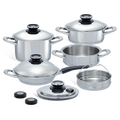
A by AMC sells its cookware in complete sets, each built for a different kind of cook rather than a different price tier. Pick the one that matches your kitchen:
- The Essential Collection is the entry point, built for a single cook or light entertainer who wants the core pieces and nothing extra.
- The Foundation Collection steps up for an active cook in a two-to-four-person household who cooks most nights.
- The Foundation+ Collection completes the kitchen, built for larger families and anyone who entertains. It is the last set most cooks will ever buy.
You are not locked into a full set, either. Individual pots, pans, and lids can be added one at a time from the A by AMC shop as your kitchen grows. And you can compare every set and see current pricing before you choose.
Spend once, on the set that fits the way you cook, and you only have to answer the how-much question one time.
Frequently Asked Questions
How much should I spend on a cookware set?
There is no single number, but the useful way to think about it is to spend enough to buy once. Budget sets run roughly $50 to $150, mid-range sets $150 to $400, and premium sets $400 and up. The cheapest sets tend to be coated non-stick, which wears out and gets replaced every few years, so over time the low-price option often costs the most. If you plan to keep your cookware for the long haul, buying quality 18/10 stainless once is usually the better value.
Is expensive cookware worth it?
It depends on what you are buying. Expensive cookware is not automatically better, a pricier non-stick pan is still not worth much, because the coating wears out. But paying more for quality 18/10 stainless usually is worth it, because it does not wear out or need replacing and often lasts for decades. The value is in buying once instead of every few years.
What is 18/10 stainless steel?
18/10 stainless steel is an alloy made of 18 percent chromium and 10 percent nickel. The chromium resists rust and keeps the metal from reacting with food, and the nickel adds strength and a bright finish. Because it has no coating to wear out, 18/10 is the grade most quality stainless cookware is built from.
Is 18/10 stainless steel cookware safe?
Yes. 18/10 stainless steel cookware has no non-stick coating, so there is nothing to scratch off into food and no PFAS or PTFE involved. The chromium forms a stable passive layer that keeps the steel from reacting with everyday ingredients, which is one reason stainless steel is a standard choice in home and professional kitchens alike.
What does A by AMC's 30-year warranty cover?
The 30-year warranty covers the stainless steel body of the cookware, the part that does the cooking and takes the wear, for the original US purchaser. Full terms are on the A by AMC warranty page.
Cook. Respond. Succeed.
A new way of cooking. Built to last. Made to repeat.
Explore the A by AMC active cookware line and find the ecosystem built for the way you cook.