



Healthy Cooking · Pillar
Healthy Cooking at Home: Methods, Nutrition and Cookware That Actually Makes a Difference
What cooking actually does to your food, which cooking methods preserve the most nutritional value, and which cookware to use to get the healthiest results.

You spend real money and real time choosing the right ingredients. The organic broccoli. The free-range chicken. The wild-caught salmon. These choices feel meaningful, and they are. But something happens between the grocery bag and the dinner plate that most people have never stopped to think about.
The organic broccoli you just paid extra for goes into a pot of boiling water and comes out ten minutes later a different vegetable. Not just softer. Those vitamins dissolve into the cooking water and are lost when you pour it off. The choice that truly matters is not just what you buy, but how you cook it.
Healthy cooking is not only about ingredients. It is about having cookware built for healthy cooking, the kind that makes the better approach the easier one.
This guide covers the science behind how cooking affects the nutritional value of food, the methods that preserve the most, and how A by AMC's closed cooking sensor-led ecosystem is built to make those methods reliable for the everyday home cook.
Why Cooking Method Matters More Than Ingredients

The biggest nutritional decisions most home cooks make happen at the store. They read the labels, choose the brighter produce, and look for quality. And then they get home and cook their vegetables in boiling water, just like they've always done.
What ends up on the plate can only be as nutritious as what survived the cooking process. Understanding healthy cooking methods is one of the most underrated factors in the nutritional outcome of any meal.
Take broccoli:
- Cooked in a full pot of boiling water for eight minutes, a floret arrives with a fraction of its original vitamins.
- Cooked with no added water in a closed environment for less time, the same floret retains most of them.
Same vegetable, same cook, same kitchen. The difference between healthier cooked vegetables and nutrient-stripped ones is determined entirely by the cooking method.
Key Factors in Nutrient Loss
Three main factors drive nutrient loss during cooking:
- Heat: High temperatures can degrade certain vitamins directly.
- Water: Water-soluble vitamins can dissolve into the cooking liquid. The longer food sits in that environment, the more nutrition is lost.
- Time: Extended cooking times allow for more nutrient loss.
The healthy cooking techniques that consistently outperform the rest address all three: controlled heat, minimal water contact, and shorter cooking time.
It's important to note that none of this means you should stop cooking vegetables. Cooking can actually make many nutrients easier for the body to absorb and use. The goal is always to create something people will enjoy eating.
The cooking methods that preserve the most nutrients are often simpler than people expect. The gap between a cooking method that preserves nutrients and one that strips them is often just a tightly closed cooking environment and a little less water.
The Science of Nutrient Loss, Simply Explained
Not all vitamins respond to cooking in the same way. Understanding these differences can help clarify why some cooking methods yield better nutritional outcomes than others.

Water-Soluble Vitamins
Water-soluble vitamins include vitamin C and the eight B vitamins. When these vitamins meet cooking water, they dissolve into it. This means that when you boil vegetables and then drain the water, you are essentially pouring some of their nutritional content down the sink.
Research shows consistent patterns across both vegetables and proteins:
- Boiling broccoli means submerging it in water long enough for much of its vitamin C to dissolve out. Steaming keeps the floret out of the water entirely, so far less is lost.
- Boiling spinach causes significant folate (vitamin B9) loss into the cooking water. Cooking it briefly in a closed, low-water environment keeps far more of that folate in the leaf.
- Boiling chicken releases B vitamins, particularly B1 and B6, directly into the cooking liquid. When that liquid is discarded, those vitamins go with it.
The difference is not the heat; both methods use heat. The crucial factor is water contact. This also explains common results in steaming vs boiling vegetables. Keeping food above or away from excess water preserves more of what you started with.
Fat-Soluble Vitamins
Fat-soluble vitamins, which include vitamins A, D, E, and K, behave differently:
- They do not dissolve in water, which means boiling is less detrimental to them.
- They are, however, sensitive to high heat and prolonged cooking times.
Foods like carrots (vitamin A), salmon (vitamin D), and spinach (vitamin K) hold onto more of their fat-soluble content through boiling than water-soluble vitamins would in the same conditions.
The risk with these nutrients is prolonged high heat, not water contact. Roasting at very high temperatures for extended periods can degrade them even without any liquid present.
Short, controlled cooking in a closed environment is better for protecting fat-soluble vitamins.
Visual Cues
There’s also a helpful visual cue to keep in mind. When broccoli changes from bright green to dull grey-green, it’s not just an aesthetic issue. This color change indicates that chlorophyll is breaking down due to prolonged heat and water exposure. Retaining vibrant colors after cooking is typically the visible sign of healthier cooked vegetables, more of the nutritional content has survived the process.
For anyone cooking for nutrition, the two things most worth controlling are water contact and cooking time. Shorter exposure, less liquid, and a closed cooking environment consistently produce better nutritional outcomes across both vitamin categories.
Cooking with Minimal Water: The Method That Changes Everything

Most people have never been shown how to cook with minimal water, as traditional cookware often doesn't support this method effectively. The idea itself is straightforward. Purpose-built cookware for minimal water cooking makes it practical for everyday kitchens.
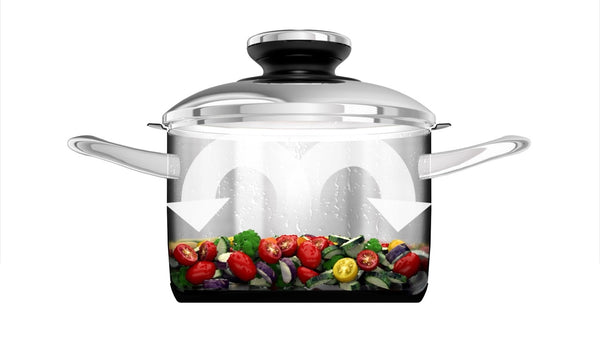
Instead of submerging food in liquid and heating the water, you trap the food's own natural moisture inside a closed cooking environment and use that moisture to steam the food from within. No added water. No liquid for the vitamins to dissolve into. The food essentially steams itself.
How It Works
In practice, minimal water cooking involves:
- A tight-fitting lid creates an enclosed chamber around the food.
- As the pot heats, the food's natural moisture turns to steam inside that chamber.
- That steam circulates and cooks the food from all sides, at a lower temperature than boiling, and in less time.
This method preserves the nutrients that would otherwise leach into boiling water, as there's no water to leach into.
Challenges and Solutions
Historically, minimal water cooking has been challenging for everyday home cooks because:
- Attention Required: If the lid doesn't close tightly, steam escapes, which can ruin the cooking process.
- Heat Control: If the heat is too high, food can burn, requiring constant vigilance.
The right cookware makes all the difference. Not every pot can maintain the closed environment and consistent base heat this method requires.
Documented Benefits
Cooking in a closed environment with minimal added water means there is nowhere for water-soluble nutrients to go except back into the food. Less water contact, lower temperature, and shorter cooking time all work in the same direction: more of what you started with stays in the dish.
The closed environment that makes this possible is exactly what A by AMC cookware is built to create. For a full explanation of the minimal water cooking method, including which vegetables work best and how to get started, read cooking with minimal water explained.
A by AMC: Cookware Built for Healthier Cooking

Knowing that minimal water cooking preserves more vitamins than boiling is useful. Having the smart kitchen tools for healthier cooking that make it practical enough for a weeknight is what actually changes what ends up on your plate.
A by AMC is an active cookware line built on 60+ years of Swiss engineering and 180+ years of family heritage, combining Swiss precision with Italian craftsmanship throughout. Every piece is made from 18/10 stainless steel: no coatings, no PFAS, no PTFE, nothing on the cooking surface that degrades over time or raises questions about what ends up in the food. The full stainless steel line carries a 30-year warranty.
The materials are the foundation. What separates A by AMC from a standard stainless steel pan isn't the steel itself, premium stainless brands use the same grade.
It's that A by AMC's cookware actually tells you what's happening inside it while you cook, instead of leaving you to guess. That's what makes these the smart kitchen tools for healthier cooking, not an app added to a normal pan, but sensors and signals built into the cookware itself. They are healthy cooking pans designed to support nutrient-preserving methods day after day.
The Five Components Behind A by AMC’s Sensor-Led Ecosystem
These five pieces work together as one active system. Heat is distributed evenly, measured in real time, and shown on the display, then the cookware signals you the exact moment to act, with the app tying the whole sequence together so you always know what stage your food is at.
Here is how the five technologies work:
- Akkutherm: A multi-layer, pressure-welded base that distributes heat evenly across the entire cooking surface. No hot spots, which is what makes cooking with minimal water and low-fat cooking reliable rather than inconsistent. A separate technology, Thermobloc, keeps the handles cool to the touch even as the base heats up.
- Sensotherm: A precision temperature sensor built into the base of the lid knob. It reads the actual temperature inside the closed cooking chamber, not the stove's dial setting.
- Visiotherm: The display built into the lid knob, showing the Sensotherm reading in real time. You can see the temperature progress inside the pot without lifting the lid and releasing the heat and moisture trapped inside.
- Audiotherm: Clips onto the Visiotherm and signals the exact moment to act, whether that is adding the ingredient at the perfect temperature or reducing the heat. It connects via Bluetooth to the Cook & Go App, so the same signal reaches your phone if you have stepped away from the stove.
- Cook & Go App: Step-by-step recipe guidance and real-time temperature monitoring, connected to the Audiotherm. The app won the Kitchen Innovation Award in 2023, after the full cooking system received the same award in 2021, including a Best of the Best distinction in the Small Electrical Appliances category.
This is what makes minimal water cooking, the method covered above, repeatable instead of something you have to babysit. The standard high-dome lid traps the moisture. Akkutherm distributes the heat, Sensotherm measures it, Visiotherm shows you the reading and the Audiotherm monitors it.
For a deeper breakdown of how all five work together, read how A by AMC's cooking ecosystem works.
Steaming with A by AMC Cookware
Cooking with minimal water and steaming both cook food without submerging it in liquid, but they are not the same thing.
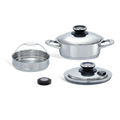
Minimal water cooking uses the standard high-dome lid that comes on every A by AMC pot. Steaming adds two more pieces: the EasyQuick lid, which replaces the standard lid to create a dedicated steaming seal, and the Softiera basket, which lifts food above the water to avoid direct contact of the food with the water. Together they turn any A by AMC pot into a steamer (without pressure), gently cooking food at just under boiling point instead of relying on the pot's own trapped moisture.
Both methods preserve more of what is in the food than boiling does. Which one you reach for depends on what you are cooking, not on which collection you bought.
Low-Fat Cooking Without Sacrificing Flavor

There is a reason most home cooks reach for the oil bottle, or a pat of butter, before the pan has fully heated. They are not doing it for flavor. They are doing it as insurance. When the exact temperature of the pan is uncertain, added fat gives food a place to slide around and helps prevent sticking.
But oil isn't the only way to solve that problem, and skipping it changes more than just the calorie count.
Better Flavor Without Oil
Cooking without oil also transforms the taste of your food, and not in a subtle way. Oil creates a barrier between the pan and the food, which means heat transfers through a layer of fat instead of making direct contact with what you're cooking.
Skip the oil, and that direct contact is what produces a real sear instead of a softer, steamed surface.
- Salmon or chicken seared at the correct temperature in a bare stainless steel pan develops a clean, direct crust.
- The natural flavors of the protein shine through, as there’s no added fat softening or masking them.
Less added fat means those flavors have nowhere to hide, which tends to make food taste more like itself. The challenge is knowing exactly when the pan is hot enough. Without oil's margin for error, timing is everything.
Remove the Guesswork
With the Visiotherm, a temperature display built into the lid of A by AMC pans, you can see the actual temperature zone inside the cooking chamber as it rises in real time, even before adding food. When the pan reaches the right temperature for searing, the pan will inform you and any guesswork disappears.
This allows you to:
- Add protein at the optimal moment, ensuring it makes contact with a surface that is ready.
- Achieve a clean release without sticking, leading to better cooking results.
- Avoid both extremes: a pan that is too cool causes sticking, while one that is too hot can burn the surface before the inside finishes cooking.
Knowing your pan temperature before you start is what makes oil-free searing practical and not just possible: better flavor and fewer calories, without having to develop a chef's instincts first. To cook without oil, trust the temperature reading, not instinct.
Hands-Free Cooking
Without oil's buffer, missing the critical moment to act, whether that's flipping, pulling the pan, or adding the next ingredient, matters more than it would otherwise. Audiotherm makes that moment audible, so you do not have to stand over the pan watching for it.
It also connects via Bluetooth to the Cook & Go App, so the same signal reaches your phone if you've stepped away from the stove entirely. That is the hands-free part, the precision oil-free cooking requires, without having to babysit the pan to get it.
Proven Results
Added fat means added calories with nothing nutritional gained in return, calories spent purely on preventing sticking. Cutting it out doesn't just lighten the dish. It also avoids what happens when oil is pushed past its smoke point: splattering, smoking, and the breakdown that comes with overheated fat.
Research from the University of Hamburg in 2009 backs this up. Roasting without added fat produces up to 50% fewer calories than conventional fat-added methods.
The absence of added fat enables the natural flavors of the food to take center stage. When it comes to low-fat cooking tips, controlled heat and timing matter more than anything else once you decide to cook without oil.
Better flavor, fewer calories, and a pan that tells you exactly when to act. That is not a tradeoff. It is simply a better way to cook.
Browse A by AMC's pan and griddle collection.
Cookware Materials: The Other Half of Healthy Cooking

The conversation about what ends up on your plate extends beyond just cooking method. What the pan itself is made of matters too, since the material can affect what ends up in your food, not just how the food is cooked.
When researching the most healthy cooking pots and pans, one question always comes up first: Does this material add anything to my food that shouldn't be there? If you're deciding on a healthy cooking pot material, consider how it behaves under everyday heat and cleaning.
Stainless Steel
For bare 18/10 stainless steel under normal cooking temperatures, the answer is effectively no. Key points include:
- Corrosion-Resistant: This grade of stainless steel is highly resistant to corrosion and does not react with food.
- No Migration: What you put in is what comes out. Nothing added, nothing taken away. That is the standard any healthy cooking pan should meet.
Non-Stick Coatings
Non-stick coatings raise different concerns. More consumers are now looking specifically for healthy cooking pans made without synthetic coatings, and for good reason:
- PFOA has been phased out of most non-stick products. The broader class of PFAS compounds, however, remains an active area of regulatory attention in multiple US states.
- Degradation: Non-stick coatings degrade with use. Once a coating starts to scratch or flake, particles can make their way into food.
A by AMC Cookware
For anyone cooking without non-stick surfaces by choice, A by AMC is built exactly that way:
- Free from Harmful Compounds: All A by AMC cookware is free from PFAS, PFOA, and PTFE, featuring no coatings on the cooking surface.
- Consistent Quality: What you see is consistent 18/10 stainless steel throughout, with no layers that can degrade over time. There are no concerns about the condition of the surface, even after years of regular use.
Coatings wear out over time. Once a surface begins to degrade, the question of what ends up in the food is worth asking. A by AMC doesn't use coatings.
For a comprehensive comparison of cookware materials, including stainless steel, cast iron, ceramic, and coated alternatives, read safe cookware materials.
Choosing the Right A by AMC Collection for Healthier Cooking

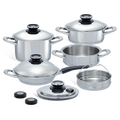
Every A by AMC collection includes the same smart kitchen tools for healthier cooking: the EasyQuick lid and Softiera basket. Cooking with minimal water and steaming are not an upgrade you add later. They come standard. The question is not whether a collection supports healthier cooking, but how much cooking beyond that you want it to handle.
If Steaming Is Your Main Method
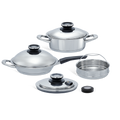
Pure Steam+ is built for cooks whose main method is minimal water cooking and steaming, and who do not need a frying pan in the set. It includes the Rondeau, a wide, shallow pot built for braising and sautéing, the Softiera basket, the EasyQuick lid, the Combi, a stacking insert that adds a second steaming level, and an Audiotherm. It is a dedicated setup, not a starter kit waiting for more pieces.
Explore Pure Steam+.
If You Want Steaming Plus Everyday Cooking
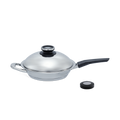
Most first-time A by AMC owners start here. The Essential Collection includes the Rondeau, Softiera basket, EasyQuick lid, and Audiotherm, plus a Frying Pan for searing, roasting, and frying with no added fat. Essential+ adds the Combi on top of that, for stacked steaming. Either is a strong starting point for a single-cook household or someone easing into the system without a full kitchen overhaul.
Explore the Essential collections.
If You're Cooking for a Bigger Household
Foundation adds a Stock Pot and a second Audiotherm, built for a 2 to 4 person household cooking most nights of the week. Foundation+ goes further with a Grill Pan and a Saucepan, for a family of four or more, or a household that entertains regularly. Both carry the same capability for cooking with minimal water and steaming as every other collection in the line.
Explore the Foundation collections.
Every A by AMC collection, regardless of size, is backed by a 30-year warranty on the stainless steel body. The methods covered in this guide work the same whether you are cooking for one or for six. The difference is capacity, not capability.
Not sure which one fits? Take our 2-minute quiz and we'll point you to the right collection.
Frequently Asked Questions
What is the healthiest cooking method for vegetables?
Cooking with minimal water, using the food's own natural moisture instead of any added water, is the most effective method for preserving nutritional content. Boiling causes water-soluble vitamins like vitamin C and the B vitamins to dissolve into the cooking water and get lost when you drain it.
Steaming avoids most of that loss by keeping food above the liquid, and minimal water cooking improves on it further by greatly reducing the amount of water needed.
Is stainless steel cookware better for health than non-stick?
Yes, from a materials perspective. 18/10 stainless steel cookware has no coatings that can wear down or raise health concerns over time. Non-stick surfaces, particularly those made with PFOA and the broader class of PFAS chemicals, have faced significant regulatory scrutiny.
A by AMC cookware is free from PFAS, PFOA, and PTFE, featuring no coatings on the cooking surface. What you cook on is bare 18/10 stainless steel throughout the product's lifespan.
Can I really cook without oil using A by AMC?
Yes. You can cook without oil for searing and roasting. Many home cooks add oil because they can't determine when the pan has reached the right temperature. Oil acts as a buffer, giving food somewhere to slide rather than stick while you're still guessing whether the pan is ready.
The Visiotherm shows the exact temperature zone inside the cooking chamber in real time, the Audiotherm even calls you when the perfect temperature zone for roasting has been reached so you know precisely when to add the food. At the correct temperature, a bare stainless steel surface releases food without sticking, making oil optional for many applications.
How does cooking with minimal water work?
Cooking with minimal water uses the food's natural moisture instead of added water. A tight lid traps this moisture inside the pot as steam, which circulates around the food and cooks it from all sides. Since the food is not lying in water, soluble vitamins are not dissolved but stay in the food.
Every A by AMC pot and pan is built for this. The lid creates the seal, the Akkutherm base ensures even, controlled heat, and the Visiotherm display lets you monitor what is happening inside. For a full explanation, read cooking with minimal water explained.
How is minimal water cooking different from steaming with A by AMC?
Both methods avoid submerging food in liquid, but they're not the same. Cooking with minimal water uses the standard high-dome lid that comes on every A by AMC pot to trap the food's own moisture. Steaming adds the EasyQuick lid for a dedicated steaming seal and the Softiera basket to lift food so it does not rest in the water. Use minimal water cooking when the food's own moisture is enough on its own. Use steaming when you want free-circulating steam, gentler heat just under boiling point, or stacked levels with the Combi insert.
What is the Pure Steam ecosystem?
The Pure Steam ecosystem is A by AMC's combination of components designed for steaming. It includes:
- EasyQuick Lid: Turns the cookware into a steamer, creating a sealed cooking environment.
- Softiera Insert: Lifts the food above the base to allow steam to circulate freely underneath.
Together, the EasyQuick lid and Softiera insert work with the Akkutherm base built into every A by AMC pot to make steaming reliable and consistent. The Akkutherm is a standard feature of the full cookware line, not exclusive to Pure Steam, which means any A by AMC pot can support this method.
Cook. Respond. Succeed.
A new way of cooking. Built to last. Made to repeat.
Explore the A by AMC active cookware line and find the ecosystem built for the way you cook.