



Healthy Cooking
Steaming vs. Boiling vs. Roasting: Which Method Keeps the Most Nutrients?
Boiling, roasting, and steaming can all put dinner on the table, but they do not all keep the same amount of the nutrients in your food. Here is how the three methods compare, and when to use each.

Say tonight is chicken, potatoes, and broccoli. You have a stove, an oven, and a few decisions to make before any of it hits the serving plate. Boil the broccoli or steam it? Roast the chicken, the potatoes, or both? Most of us make those calls out of habit. They are also nutrition decisions, even though they rarely feel like it.
Each cooking method treats food differently. Boiling surrounds it with water. Roasting surrounds it with hot, dry air and browns the surface. Steaming cooks it in vapor without ever submerging it in the water. Those differences determine how much of the vitamins and nutrients actually remain in your food. Steaming keeps the most of them, but that does not make boiling and roasting mistakes. They are better at other jobs.
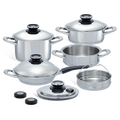
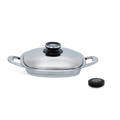
The cookware matters as much as the method. A by AMC is an active cookware line designed around steaming and cooking with minimal water, the two gentlest methods in this comparison, and it sears and roasts meat with no added oil or fat. Start with where the nutrients actually go when you cook, and the rest of it makes more sense.
How Cooking Method Affects Nutrients
Nutrient loss comes down to three things: heat, water, and time. Every cooking method is a different mix of them, which is why the same food can reach the table with very different nutrition depending on how you cooked it.
What heat, water, and time do
- Heat: high temperatures break down some vitamins, especially vitamin C and several of the B vitamins.
- Water: water-soluble vitamins and minerals dissolve into cooking liquid and leave with it when the pot is drained.
- Time: the longer food cooks, the more of both of those things happen.
The methods that hold onto the most nutrients keep all three low: gentle heat, minimal water, and a short time on the stove. That is why the same broccoli can come out of two pots looking like two different vegetables, and why a chicken breast can come out juicy from one pan and dry from another.
Why the same food comes out differently
"Cooking" covers a lot of ground. Boiling water, steam, and dry oven air each do something different to the food they touch. Research on how cooking affects vegetables has found that methods which do not submerge food in water hold onto more of its nutritional value, because there is no cooking liquid for water-soluble nutrients to escape into.
Meat and fish follow the same rule. For example, boil chicken to shred for tacos, and some of its B vitamins leach out into the water you pour down the drain. Boiling is generally harder on the B vitamins in meat than any other cooking method. For the bigger picture of how cooking affects nutrition, and the cookware behind it, our guide to healthy cooking at home covers it in depth.
Boiling: Fast, Familiar, and Costlier Than It Looks

Boiling is the method most of us learned first. It is quick, forgiving, and works on almost anything. It is also the method that loses the most nutrition, and it does that to vegetables in particular, along with meat and everything else you put in the pot.
Where the water-soluble vitamins go
Some vitamins dissolve in water and some do not. The ones that do are vitamin C and the B vitamins, including thiamine, riboflavin, niacin, and folate. Place food in a pot of boiling water and those vitamins move out of the food and into the liquid around it. Pour the liquid down the drain and the vitamins go down with it. Vitamins A, D, E, and K do not dissolve in water, so boiling leaves them largely alone.
Does boiling vegetables actually remove nutrients? It removes some, and specifically the water-soluble ones. In studies of common vegetables, boiling caused the largest drop in vitamin C of any method tested, and the loss traced straight back to vitamins dissolving into the water. You can also see it happening. Bright green fading to a dull gray-green is heat and water breaking down the chlorophyll, and the vitamins are going the same way.
When boiling is the right call
None of that makes boiling a mistake. Nothing is really lost if you keep the liquid, and plenty of cooking does exactly that. Chicken soup, chili, stock, a pot of chowder: the vitamins that come out of the food are still in the bowl you serve. Pasta and potatoes are the everyday exceptions that go the other way, since you drain both, though neither is carrying much vitamin C to begin with.
Boiling can also be the better choice outright. One research review found that peas held onto more folate, a B vitamin, after boiling than after other methods. No method wins at everything, and it depends on the food and the nutrient you care about. For most foods, boiling only costs you when you throw the water away.
Roasting: Big on Flavor, Harder on Some Vitamins

Roasting and baking cook food with hot, dry air. Since the food is not sitting in a pot of water, the leaching that happens in boiling does not happen here. Roasting loses nutrients a different way, through heat and time, and it gives back something the wet methods cannot.
What dry heat does well
Dry heat browns the outside of food, and that browning creates a flavor no wet method can produce. Think of the crust on a roast chicken or the caramelized edges of a potato. That deep, savory character comes from the Maillard reaction, the browning that happens when heat meets the proteins and natural sugars in food. Roasting also concentrates flavor by driving water off instead of adding it.
With no cooking water for vitamins to escape into, plenty of nutrients come through fine, and a few come through better than fine. Carotenoids are the orange and red pigments in carrots, sweet potatoes, and tomatoes, and some of them your body converts into vitamin A. Cooking makes them easier to absorb, and in one study of carrots, baking gave the biggest increase of the four methods tested.
What dry heat takes away
The damage comes from heat and time instead. Vitamin C and some of the B vitamins break down at high temperatures, so a long stretch in a hot oven or pan wears them down even with no cooking water involved.
Meat is no different. Roast a chicken longer and hotter than it needs and you lose B vitamins the same way. Cut things to a similar size, and pull them out when they are done rather than when the timer says so, and you get the browning without pushing the heat-sensitive vitamins past their limit.
When to choose roasting
Roast when you want that browned, caramelized flavor. A whole chicken, a pork loin, a beef roast, potatoes and carrots browned at the edges, a salmon fillet you want firm rather than soft. You give up some vitamin C and some B vitamins in exchange, and for most of these foods that is a favorable trade.
Roasting without an oven, and without oil
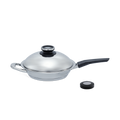
A by AMC roasts on the stovetop rather than in the oven, and it does it without adding any fat. That second part is the harder trick. Most of us pour oil in a pan as insurance rather than for flavor, because we cannot tell how hot the pan is and oil keeps food from sticking and burning.
A by AMC takes the guessing out of it. A sensor in the lid reads the temperature inside the pan, and a display on the lid knob called the Visiotherm turns that reading into cooking zones you can see at a glance. When the indicator reaches the roasting window, the pan is at the right heat to sear meat or poultry, and that is the cue to add it.
The same Maillard browning that makes an oven roast taste good happens right there in the pan, with nothing poured in first. University of Hamburg research from 2009 compared meat roasted with no added fat against meat cooked conventionally and found the no-fat method saves up to 50% of the calories. Our breakdown of how A by AMC's cooking system works covers the rest of it.
Steaming: Healthier Cooked Vegetables, and a Lot More
If you want healthier cooked vegetables with the most nutrients left in them, steaming is usually the healthiest way to cook vegetables and get there. It avoids boiling's leaching problem and roasting's high heat at the same time, which is why it comes up so often as the healthiest way to cook vegetables. And it is not only about healthier cooked vegetables, since steaming does the same job for foods like fish, shellfish, and eggs.

No immersion, no leaching
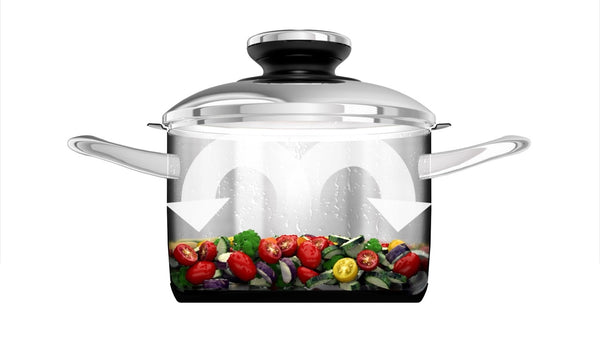
Steaming cooks food in the heat of rising steam instead of submerging it in water. Since the food never sits in liquid, the water-soluble vitamins have far less to dissolve into, so more of them stay in the food. In research on broccoli, one of the most-studied vegetables for this question, steaming broccoli came out ahead of other methods for holding onto its nutrients and beneficial compounds.
Gentle heat, brighter color, less loss
Steam cooks at about the temperature of boiling water, gentler than a hot oven and without the long stretch of high heat that wears down delicate vitamins. That is why steaming broccoli keeps it deep green and steamed carrots stay bright, and that color is a good sign that more of the vitamins came through too.
Steaming is not just for vegetables
The same rule holds for anything you put over the steam instead of in the water. Fish and shellfish are the clearest case. Salmon, cod, shrimp, clams, and mussels all steam well, and the gentle heat keeps them from going tough or dry the way a hot pan without heat control can. Steaming eggs works well too, and so does gentle steaming of chicken and dumplings. Much of what you would otherwise boil and drain can be steamed instead. Not everything, since pasta has to be in the water to cook. But most vegetables, fish, shellfish, and rice steam just fine.
Steaming without guesswork
Steaming rewards a steady, closed cooking environment, and that is what A by AMC is designed to do. Every pot is 18/10 stainless steel with no coatings, and the base spreads heat evenly across the whole surface, so the steam stays consistent instead of surging in one spot and stalling in another.
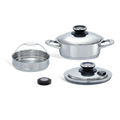
Two pieces turn any A by AMC pot into a gentle steamer. EasyQuick is a lid that closes the pot for steaming without pressure, and Softiera is an insert that lifts the food above the water so steam can move around it freely.
The Visiotherm display (integrated into the lid knob) does more than tell you when a pan is hot enough to sear. It also shows what is happening inside the closed pot while it steams, so you are not lifting the lid to check and letting the steam out. Add the Audiotherm, an acoustic assistant that clips onto the Visiotherm, and you do not have to watch at all. It displays the actual temperature zone inside the pot and signals when it is time to do something.
Steaming has a close relative worth knowing about. Steaming still puts water in the pot, just underneath the food instead of around it. Cooking with minimal water uses the moisture already in the food, plus whatever is clinging to it from rinsing. Less water in the pot, and less for the vitamins to escape into.
Our full explainer on cooking with minimal water covers how it works and which foods suit it best. A by AMC's own practical guide to nutrient preservation is a useful companion for everyday cooking.
Healthy Cooking Methods, Side by Side
Which method to use comes down to what you are cooking and what you want out of it.
| Method | Best for | What it keeps | What you give up |
|---|---|---|---|
| Steaming | Broccoli, green beans, asparagus, cauliflower, salmon, cod, shrimp, mussels, eggs, rice, quinoa, and other grains | The most vitamin C and B vitamins of the three | Browning and crust |
| Boiling | Chicken soup, chili, stock, chowder, stews, pasta, potatoes | Most of it, as long as the liquid ends up in the bowl | Vitamin C and B vitamins any time you drain the pot |
| Roasting | Whole chicken / chicken breasts, pork loin, beef roast, salmon fillet, burger patties, potatoes, and carrots | Carotenoids, and it makes them easier to absorb | Some vitamin C and B vitamins to the heat |
Which A by AMC set fits how you cook
Most of that table is covered by one set. A by AMC does the gentle methods well, steaming and cooking with minimal water, and the same cookware sears and roasts at high heat when you want a crust on a steak or a chicken breast. Our five easy starter recipes run from steamed to seared in a single set if you want to see it in practice.
Every A by AMC collection steams and cooks with minimal water. That comes standard rather than as an upgrade you add later. What changes between them is how much else they take on.
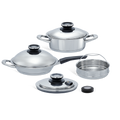
If steaming is most of what you cook, Pure Steam+ is a dedicated setup for it. You get the Rondeau, the EasyQuick lid, the Softiera basket, a Combi insert that adds a second steaming level, and an Audiotherm. There is no frying pan in the set.
If you want the searing and roasting too, the Essential Collection is where most people start. Same steaming setup, plus a Frying Pan for searing and roasting with no added fat. Essential+ is that same set with the Combi included, if you want a second steaming level as well.
Frequently Asked Questions
Which cooking method keeps the most nutrients?
Steaming, for most foods. It keeps the food out of the water, so the water-soluble vitamins have nowhere to leach off to, and it uses gentler heat than roasting. Cooking with minimal water works on the same idea, using the moisture already in the food. Boiling loses the most, and roasting trades some vitamins for flavor, but each still has foods it handles better than steaming.
What is the healthiest way to cook vegetables?
Steaming, or cooking with minimal water. Both keep vegetables out of the cooking water, which is where vitamin C and the B vitamins are lost when you boil and drain. Moderate heat and a short cooking time help too, since these vitamins also break down the longer and hotter you cook. The best way to cook vegetables and keep the most nutrients is to use gentle heat and little water, and bright color in the vegetables is a good sign it worked.
Does roasting food destroy its nutrients?
Less than you might think. High heat does break down some vitamin C and B vitamins, and a long roast breaks down more. But nothing is leaching into a pot of water, so the losses are smaller than boiling in that respect. Roasting even helps with carotenoids, the pigments in carrots and sweet potatoes, by making them easier for your body to absorb.
Steaming vs boiling: which keeps more nutrients?
For most foods, steaming. Boiling draws water-soluble vitamins like vitamin C and the B vitamins out of the food and into the water, which usually goes down the drain. Steaming holds the food above the water, so more of those vitamins stay in it. The exception is a dish where you keep the cooking liquid. Boil vegetables into a soup and nothing is really lost, because the vitamins that leave the food are still in the broth you eat.
Does A by AMC cookware help retain nutrients?
Yes. Steaming and cooking with minimal water are the two methods that keep the most vitamins in, and A by AMC is built for both. A sensor in the lid reads the temperature inside the closed pot, and the Visiotherm display on the lid knob turns that into cooking zones you can read at a glance, so you can hold a gentle heat without lifting the lid to check. Keeping the heat gentle and the water low is what protects the nutrients.
Cook. Respond. Succeed.
A new way of cooking. Built to last. Made to repeat.
Explore the A by AMC active cookware line and find the ecosystem built for the way you cook.