



Non-Toxic Cookware · Pillar
Non-Toxic Cookware Guide: Safe Materials, What to Avoid, and Brands You Can Trust
What "non-toxic" actually means, how PFAS, PFOA, and PTFE relate to each other, how the major cookware materials compare on safety, and where to start if you want cookware you stop having to think about.
If you have spent any time shopping for non-toxic cookware lately, you have probably noticed that almost every pan claims to be non-toxic. PFOA-free, PFAS-free, ceramic, natural, eco-friendly. The labels pile up, and most of them are technically true without telling you what you actually need to know.
By the end of this guide, you'll know which labels are worth trusting, why "PFOA-free" doesn't mean what most people think it means, and how the major cookware materials actually hold up once the coating wears off. Then you'll know exactly what your next pan should be made of.

What Does "Non-Toxic" Actually Mean?
One key aspect that most non-toxic cookware brands do not address is that "non-toxic" is not a regulated term. According to an FDA official who oversees food contact substances, the agency has no official definition for "nontoxic" when it comes to cookware. No government agency certifies cookware as non-toxic, and there is no official seal, standard, or third-party approval to substantiate this claim. Any manufacturer can print "non-toxic" on their labels, and most do.
However, this does not mean the term lacks significance. It simply places the responsibility on you to understand what to look for, as the label alone may not provide sufficient information.
A truly non-toxic pan needs to meet three essential criteria:
- Chemical Stability: The material must remain chemically stable at real cooking temperatures, not just at room temperature on a store shelf. A material that is safe when cool but releases harmful fumes when heated does not meet the true definition of non-toxic.
- Durability of the Food-Contact Surface: The part of the pan that touches your food must stand the test of time. If it can chip, scratch, or wear away, the "non-toxic" claim only describes the pan when it's new, not after years of use.
- Sealing of Reactive Metals: Any reactive metals in the pan's construction, such as aluminum or copper, which are used for their excellent heat conduction, must remain sealed inside the pan and never come into direct contact with food.
Keep these three criteria in mind as you continue reading. They will serve as the lens through which we evaluate each cookware material in this guide and the critical questions to ask when choosing a healthy, truly non-toxic cookware material.
For a closer look at why this question matters for your health and your kitchen, why non-toxic cookware matters is a good place to start.
PFAS, PFOA, and PTFE: What They Are and Why It Matters
PFAS, PFOA, and PTFE get used interchangeably when people talk about cookware, but they are three different things.
PTFE
PTFE is a coating material known for being slick and slippery, most people know it by its original brand name, Teflon. It's still used in the vast majority of nonstick pans sold today. PTFE itself belongs to a larger family of chemicals called PFAS, which we'll get to next.
When used at low to medium heat and replaced regularly, PTFE coatings are not considered acutely dangerous for most adults, so the honest answer to "is PTFE cookware safe" depends largely on heat exposure and how worn the coating is. The two main concerns regarding PTFE are its heat sensitivity and lifespan, both of which we will address in the materials comparison section below.
PFOA
PFOA was a chemical used to make PTFE. It wasn't part of the finished coating, but it was used in manufacturing it, and it was the focus of most of the early lawsuits and health concerns around nonstick cookware.
US manufacturers phased PFOA out of production by 2015. That's why "PFOA-free" shows up on nearly every nonstick pan sold in the US today, including ones that still use PTFE coatings. It's basically a default label at this point, not something that sets a pan apart. We'll get into what that means for reading labels later in this guide.
PFAS
PFAS, or per- and polyfluoroalkyl substances, is an umbrella term that encompasses both PTFE and PFOA, along with about 15,000 other synthetic compounds. These substances feature strong carbon-fluorine bonds, which make them effective in coatings as they resist heat, repel water, and do not break down easily under normal conditions.
This same durability prevents PFAS from breaking down in the environment or in the human body once they enter. Because of this, PFAS compounds are often referred to as "forever chemicals." While not every PFAS has the same health risks and research is ongoing, the long-lasting nature of these compounds raises concerns once they are released into the environment.
Where the Regulatory Picture Stands
This context leads to the emergence of new state-level regulations. As of January 1, 2026, Maine's expanded PFAS rules prohibit the sale of cookware that contains intentionally added PFAS. Maine joins Minnesota, Colorado, and Connecticut in implementing cookware-specific restrictions, with more states anticipated to follow.
At the federal level, the EPA has set legally enforceable limits for PFOA and PFOS in drinking water as of 2024, implementing some of the strictest standards for any contaminant. By mid-2026, the EPA proposed extending the compliance timeline for public water systems while keeping the limits in place. As a result, while enforcement dates are still subject to change, the standards themselves remain firm.
The Centers for Disease Control and Prevention has found PFAS in the blood of nearly all Americans tested through its ongoing national health survey. While this does not indicate a crisis in your kitchen, it does signal that this is an area of active regulatory focus and should not be overlooked when making informed choices.
For the full consumer-side breakdown of what these labels and laws actually mean, see The Truth About “Non-Toxic” Cookware.
How Cookware Materials Compare on Safety
Using the criteria from above, here is how the most common cookware materials measure up.

18/10 Stainless Steel
18/10 stainless steel has no coating. The cooking surface is the metal itself, an alloy of 18 percent chromium and 10 percent nickel. Nothing is applied to the surface, so there is nothing to degrade, chip, or wear away, and no temperature limit to worry about. It clears all three safety criteria without qualification. For most kitchens, this is the safest cookware material for daily use and a reliable non-toxic cookware material.
The only practical consideration is technique. Food can stick to stainless steel if the pan is not properly preheated, but that is a cooking habit, not a safety issue. We cover it briefly in the next section.
Ceramic-Coated
In most consumer cookware, "ceramic" refers to a thin coating, often a sol-gel or silica-based formula, applied to an aluminum pan body rather than a pan made entirely of solid ceramic material. This coating is PFAS-free, which is a real advantage over PTFE and explains why ceramic non-toxic cookware has become so popular among shoppers comparing PFAS-free cookware options.
The trade-off is durability. Ceramic coatings show visible wear faster than people often expect, sometimes within just a couple of years of regular use. High heat, metal utensils, abrasive sponges, and dishwasher cycles all speed this up.
Once the coating wears through, the aluminum underneath is exposed to food, and the non-stick, PFAS-free benefits the coating provided are gone with it. Ceramic checks the safety box at the coating level, but it does not hold up over the life of the pan.
Traditional Nonstick (PTFE)
PTFE-coated pans perform well at low to medium heat when new, but the coating begins to break down above 260°C / 500°F, and an empty pan left on a high gas burner can reach that temperature in just three to five minutes. Once degradation starts, the coating releases ultrafine particles and gaseous fluorocarbons. If you're asking "is PTFE cookware safe," it depends on careful use and replacement timing, which is why many home cooks look for alternatives over time.
PTFE coatings don't last forever, and they tend to lose their integrity well before a stainless pan would show any wear at all. PTFE itself falls under the broader PFAS family, and with state bans on intentionally added PFAS now in effect, traditional nonstick cookware faces real questions on both safety and longevity.
Hard-Anodized Aluminum
Aluminum that has been electrochemically treated for a harder, more corrosion-resistant surface. No PTFE or ceramic coating, which puts it ahead of traditional nonstick.
It is still an aluminum pan underneath, though. The anodized layer can wear down with abrasive cleaning, and once it does, the aluminum behaves like any other aluminum cookware. A step up from coated aluminum, but not in the same league as a material with no reactive metal at all.
If you want the full breakdown of how these materials hold up under real cooking conditions, including the legal landscape state by state, our complete materials comparison covers it, including how stainless steel, non-stick, and ceramic compare on maintenance and replacement cycles.
How to Read Cookware Labels (And Where They Mislead)
Cookware labels are not regulated in the same way that food labels are. A manufacturer can put terms like "PFOA-free," "ceramic," or "non-stick" on a box, and while these claims can be technically accurate, they may still omit important information you need. Below are the four key areas where label language can create misleading impressions.
"PFOA-Free" Does Not Mean PTFE-Free
PFOA was phased out of manufacturing over a decade ago. As a result, "PFOA-free" is now true for nearly every nonstick pan on the market, including those that still use PTFE coatings. Since PTFE is part of the PFAS family, if a label states "PFOA-free" but does not mention PTFE or PFAS, the pan most likely still contains a PTFE coating.
Some labels combine all three claims at once, PFAS, PFOA, and PTFE free, so it's worth checking whether that means no fluoropolymer coating at all, not just no PFOA. This is the most common label gap and one of the easiest to overlook.
"Ceramic-Coated" Does Not Mean the Pan Is Made of Ceramic
As covered above, most "ceramic" cookware is aluminum with a thin coating, not solid ceramic. The label rarely says so outright, so look at the rest of the listing instead. "Ceramic-coated," "ceramic nonstick," and "with a ceramic interior" all mean a coating.
"100% ceramic" or "solid ceramic" usually means the real thing, and it tends to weigh more and cost more. If the listing doesn't specify and the price looks like ordinary nonstick pricing, assume it's a coating.
"Non-Stick" Describes Performance, Not Materials
"Non-stick" describes how a pan performs when it's new. It doesn't tell you what the coating is made of, how long it lasts, or what happens to it over time. A pan can be accurately labeled non-stick when you buy it and have a different safety profile a few years later, once the coating starts to wear.
What the Absence of a Claim Tells You
Often, the most reliable signal comes from what is not stated on the label. A pan made entirely of one material with no coatings does not require any coating disclosures because there is nothing to disclose. If a product lacks any claims such as PFAS-free, PTFE-free, or non-stick on its packaging, that absence can be the strongest indication that there is no coating applied in the first place.
Why 18/10 Stainless Steel Is the Safest Cookware Material

Here's how 18/10 stainless steel holds up against the same three criteria from the start of this guide.
- Chemically Stable at Cooking Temperatures: There is no coating to degrade, so there is no temperature threshold to worry about. Searing, broiling, and oven use well above 500°F are all perfectly fine.
- Durable Surface: The cooking surface is the metal itself. There is nothing layered on top that can chip, flake, or wear away into your food.
- Reactive Metals Stay Inside the Construction: The chromium and nickel in 18/10 stainless steel, consisting of 18 percent chromium and 10 percent nickel, are alloyed directly into the steel itself rather than being applied as a separate layer that could separate or migrate.
Stainless is the only one of these materials that clears all three. The others all come with a tradeoff somewhere. If you're comparing options for the best non-toxic stainless steel cookware, prioritize uncoated 18/10 construction.
As a reflection of our commitment to wellness and product integrity, all A by AMC cookware is manufactured without non-stick coatings or toxic chemicals that could contaminate food. All A by AMC products are free from PFAS, PFOA, and PTFE.
A coating is exactly what wears out and raises the safety questions this guide just walked through. There's nothing here that can fail the same way.
What "Safest" Looks Like Over Time
Any material can look safe when it's brand new. The harder question is how it holds up after years of regular use. A coating that's PFAS-free out of the box can still degrade, and once it does, the safety picture changes, even if the original label was accurate.
18/10 stainless steel doesn't have this problem, because there's no coating to break down. The chemical safety profile doesn't change over time the way it does with a coated pan, even if the surface itself shows wear from years of use.
That durability is backed by A by AMC's 30-year warranty on the stainless steel body, covering material, manufacturing, and functional defects.
Material safety is just one aspect of choosing non-toxic cookware. If you are also considering how cooking methods affect nutrition and everyday health, healthy cooking at home with A by AMC expands on that topic.
A by AMC: Safe Cookware with Sensor-Led Technology

A by AMC's cookware is made entirely from 18/10 stainless steel: no coating, nothing layered on top of the metal, nothing to leach or flake off over time. That base gives you a dependable non-toxic cookware material.
That standard comes out of 60+ years of engineering and 180+ years of family heritage, combining Swiss precision with Italian craftsmanship. A by AMC combines the highest quality materials with the latest technology in smart cookware. The pot, lid, and app work together as one system, tracking heat and timing while you cook and telling you what's happening inside and when to act, instead of leaving you to guess.
Even Heat, Built Into Every Base
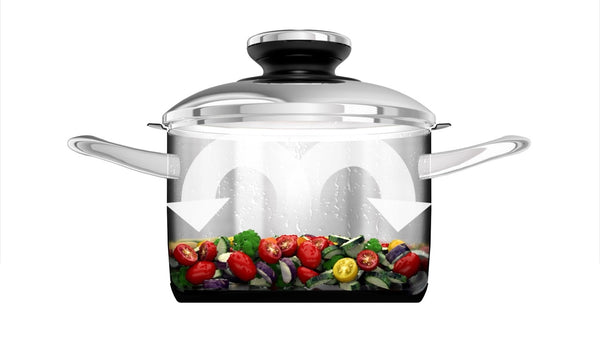
Every piece of A by AMC cookware uses the same multi-layer, pressure-welded construction called Akkutherm. It's engineered to absorb heat quickly and spread it evenly across the cooking surface, which means fewer hot spots and more consistent results. The handles use Thermobloc, a separate cool-touch handle technology, to stay cool while the base heats up.
A by AMC's Sensor-Led Ecosystem
Beyond the material itself, A by AMC is an active cookware line built around a responsive sensor-led ecosystem that tracks what's happening inside the pot and tells you when to act instead of leaving it to instinct.
- Sensotherm: A precision temperature sensor built into the base of the Visiotherm display. It reads the actual cooking environment inside the closed lid, not the stove's dial setting
- Visiotherm: The display built into the lid knob itself, showing the live cooking zone based on what Sensotherm measures. You can see the temperature zone without lifting the lid and losing the heat and moisture trapped inside.
- Audiotherm: Clips onto the Visiotherm, mirrors the same reading on its own display, and signals the exact moment to act, whether that's adding the ingredient at the perfect temperature or reducing the heat.
- Cook & Go App: Connects to the Audiotherm over Bluetooth, so the same signal reaches your phone if you've stepped away from the stove. The app won a Kitchen Innovation Award in 2023, after the full cooking system was recognized with the same award in 2021, including a Best of the Best distinction in the Small Electrical Appliances category.
Together, these components turn what's happening inside the pan into something you can see and hear instead of something you have to guess. Cook, respond, succeed, and each meal gets a little more predictable than the last.
For the complete picture of how all five components work together, read how A by AMC's cooking ecosystem works.
Building a Non-Toxic Kitchen: Where to Start
If you're looking at your current cookware and wondering how to begin building a non-toxic kitchen, here’s a practical order of operations. Remember, you don't need to replace everything in your kitchen all at once.
Step 1: Replace Non-Stick First
Start by replacing non-stick cookware, as this is where the highest-risk daily contact occurs. The coatings on these pans are the most fragile, and it's easy to exceed the temperature threshold for PTFE degradation on a hot burner. If you have a non-stick skillet that you use every morning, that should be your top priority. It’s also likely the pan in the worst condition, given its frequent use.
Step 2: Put Ceramic on a Replacement Schedule
Ceramic-coated cookware offers a better alternative to PTFE, but it still degrades over time, often sooner than people expect. You don’t need to discard these pans immediately; instead, monitor them for visible wear, scratching, or dulling of the coating. Plan to replace them on a schedule rather than waiting for the coating to fail completely. Consider ceramic cookware a transitional option rather than a permanent solution.
Step 3: Invest in Stainless as the Foundation
18/10 stainless steel serves as an excellent long-term foundation for your cookware collection. Although the upfront cost may be higher, it is ultimately the more affordable choice over time. A non-stick pan that needs replacing every few years adds up over a decade, while A by AMC backs its stainless steel cookware with a 30-year warranty.
By investing in stainless steel, you eliminate the ongoing replacement concern entirely and move toward what many consider the best non-toxic cookware for long-term use.

Choosing a Starting Point
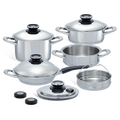
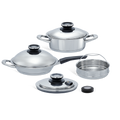
Every A by AMC collection starts from the same 18/10 stainless steel foundation. The only real difference is size and how many pieces of the ecosystem come with each collection. Each collection functions as a non-toxic cookware set designed for long-term use. If you need more capacity or broader coverage, choose one of the larger options below.
- Cooking for one or two people: The Essential Collection is a solid starting point, including one Audiotherm to monitor whatever's on the stove.
- Cooking most nights of the week: The Foundation Collection adds the extra capacity a busier kitchen uses, including a second Audiotherm so you can track two pans at once.
- Larger household or entertaining often: Foundation+ rounds things out with a grill pan and a saucepan, covering more cooking methods.
People comparing best non-toxic stainless steel cookware often start with these collections to cover everyday cooking needs without coatings.
Still deciding? Take our 2-minute quiz for a personalized match. Or browse the full range below.
You can browse the full range, including current pricing, at A by AMC cooking systems.
Frequently Asked Questions
What is the safest non-toxic cookware?
18/10 stainless steel with no coating. There's no coating to degrade, chip, or release over time. The cooking surface is the metal itself. A by AMC's cookware is made from 18/10 stainless steel and is free from PFAS, PFOA, and PTFE. For many home cooks, this is also the best non-toxic cookware for long-term value.
Is stainless steel cookware non-toxic?
Yes. "Is stainless steel cookware safe?" is one of the most common questions we hear, and 18/10 stainless steel has no coating between the metal and your food and does not react with food under normal cooking conditions. The roughly 10 percent nickel in 18/10 is alloyed directly into the steel, not a separate layer, so it is not the same as nickel exposure from jewelry.
What are PFAS in cookware and why do they matter?
PFAS, or per- and polyfluoroalkyl substances, refer to a family of roughly 15,000 synthetic compounds that do not break down easily in the environment or the body. In cookware, the most pertinent PFAS is PTFE, which is commonly used as a coating in traditional nonstick pans. As of 2026, several US states have banned the sale of cookware containing intentionally added PFAS. For a full explanation, see the section above on PFAS, PFOA, and PTFE.
Is ceramic cookware actually non-toxic?
Most ceramic coatings are PFAS-free, which is a real plus over PTFE. But "ceramic cookware" usually means an aluminum pan with a ceramic-style coating, not a solid ceramic pan, and that coating tends to wear out faster than people expect. If you're asking, "is ceramic cookware safe," remember that the safety benefits rely on a coating that can wear down over time. For the full picture, our complete materials comparison breaks it down.
Is non-stick cookware safe if I do not overheat it?
Mostly. Used carefully at low to medium heat, modern nonstick pans aren't considered acutely dangerous for most adults. But an empty pan left on a high burner can reach the PTFE degradation threshold within a few minutes, and the coating wears down over time no matter how careful you are. If you'd rather not have to think about how you're using the pan, stainless steel is the simpler choice.
What does PFAS-free actually mean on a cookware label?
It depends on which PFAS. "PFOA-free" is true of nearly every nonstick pan sold today since PFOA was phased out of manufacturing by 2015, but that does not mean the pan is free of PTFE, which is itself part of the PFAS family. A pan that is truly free of all PFAS has no fluoropolymer coating at all, which is the case for uncoated materials like 18/10 stainless steel.
Cook. Respond. Succeed.
A new way of cooking. Built to last. Made to repeat.
Explore the A by AMC active cookware line and find the ecosystem built for the way you cook.