



Non-Toxic Cookware
Stainless Steel vs. Non-Stick vs. Ceramic: Which Is Safest for Everyday Cooking?
A clear-eyed look at how stainless steel, non-stick, and ceramic hold up on safety, on daily wear, and which one is still safe to cook on years from now.

You have cooked with the same pan for years. Over the months the surface changes. A few scratches, maybe a spot where the coating looks thinner than it did. And you start to wonder whether it is still fine to cook on, or whether you have been quietly feeding your family something you would rather not.
That instinct is worth taking seriously, because cookware really can affect your health. Stainless steel, non-stick, and ceramic are the three materials most home cooks choose between, and all three are safe when they are new. The real question is what happens after that. Which one is still safe to cook on after a year of real heat, real scratches, and real everyday use.
Here is the short version. Stainless steel stays safe because there is nothing coated on it to break down. Non-stick and ceramic are safe as sold, but their safety leans on a thin coating, and coatings wear.
Cookware Safety at a Glance
A pan can look perfectly safe on the day you buy it. The real differences between these materials appear over months of cooking, scratching, and washing. The table below compares the common cookware materials across the details that shape how safe and how durable each one turns out to be, including whether it relies on a coating and how much heat it can take.
| Material | Coating? | Safe as sold | What changes with everyday use | Practical heat ceiling | Main thing to watch |
|---|---|---|---|---|---|
| 18/10 stainless steel | None | Yes | Nothing chemical, only cosmetic marks | Very high, oven and broiler safe | Food sticks if the pan is not brought up to temperature first |
| Non-stick (PTFE) | Yes, fluoropolymer | Yes, at low to medium heat | Coating thins and can flake, fumes if overheated | About 500F before the coating breaks down | Overheating and a worn coating |
| Ceramic (sol-gel) | Yes, silica based | Yes | Coating wears faster than expected, often in 1 to 3 years | Moderate, high heat shortens its life | Losing the coating and exposing aluminum |
| Cast iron | None, seasoned | Yes | Builds seasoning, adds iron to food | Very high | Rust if not dried, metallic taste with acid |
| Aluminum (bare) | None, but reactive | Depends | Reacts with acidic food unless anodized | High | Bare, un-anodized surfaces with acid |
Now let's look at each material on its own, starting with stainless steel. It has a reputation for being both the safest option and the trickiest to cook with, and it is worth understanding why.
Is Stainless Steel Cookware Safe?

Yes. Stainless steel is the safest of the three, and the reason is simple. There is no coating on the surface, so there is nothing that can break down and end up in your food.
No coating, nothing to break down
The cooking surface is the alloy itself. Nothing is layered on top that can chip, flake, or wear into your food, which also means a scratch stays cosmetic rather than becoming a problem. A scratched non-stick or ceramic pan has lost part of its protective layer. A scratched stainless pan is just a scratched pan.
And because there is no coating that can be damaged by heat, stainless steel handles searing, the oven, and the broiler with no temperature limit to worry about.
What about nickel and chromium?
The "18/10" in quality cookware refers to what the steel is made of, roughly 18 percent chromium and 10 percent nickel blended into the metal itself. Both metals are part of the alloy, not a layer sitting on the surface, so they stay locked in the metal during everyday cooking. The chromium is the workhorse here. It is what makes the surface corrosion-resistant and keeps it from reacting with your food in the first place.
That still leaves the common question of whether nickel makes its way into food. A peer-reviewed study in the Journal of Agricultural and Food Chemistry measured exactly that, and the numbers are reassuring. Any measurable transfer was highest when a pan was brand new and used for a long, acidic simmer, then dropped off over the first few uses. Even at its highest, it was tiny next to the nickel most people already get from food every day.
The practical takeaway is simple. A quality 18/10 pan is safe for everyday cooking, and the tiny amount of transfer only drops further as the pan breaks in. There is no coating to wear out and replace, so a good stainless pan will outlast the kitchen it sits in.
The real trade-off is technique
The one genuine drawback of stainless is not safety, it is technique. Food sticks when it hits a cold pan, because the surface has none of the slickness a coating provides. The fix is a simple habit. Let the pan heat up to the right temperature before the food goes in, and wait for it to release on its own rather than forcing it. How long that takes depends on your stove, and many foods, like meat or skin-on fish, need little or no added fat once the pan is properly heated.
Cooks who switch from non-stick sometimes expect stainless to behave the same way and give up early, but within a few sessions the timing becomes second nature and food releases cleanly.
Is Non-Stick (PTFE) Cookware Safe?

Yes, under the conditions most people actually cook in. Most non-stick pans are coated with PTFE, the fluoropolymer sold for years under the name Teflon. When the coating is intact and the heat stays low to medium, regulators including the FDA consider it safe to cook on. Two things change that picture: high heat and everyday wear.
Safe until it gets hot
PTFE is stable at everyday cooking temperatures and only becomes a problem when it gets very hot. The coating starts to give off fumes at around 500F, and above roughly 660F those fumes are enough to affect people.
Ordinary cooking rarely gets there, because food in the pan keeps the surface well below that point. The risk is an empty pan left on a high burner, which can climb past 500F in minutes. The real question with non-stick is not whether it is toxic, but whether it is kept at sensible heat and replaced once it wears.
Teflon flu, and why birds are the warning
Those fumes have a documented effect. Inhaling them causes a temporary, flu-like illness that clinicians call polymer fume fever, and cooks have nicknamed the Teflon flu.
Symptoms appear a few hours after exposure and usually clear within a day or two in fresh air. The sharper warning is what the same fumes do to pet birds, whose respiratory systems are sensitive enough that an overheated pan can be fatal. If you have a pet bird, that alone is reason to avoid PTFE-coated cookware.
The coating has a clock on it
The bigger everyday issue is wear. Metal utensils, abrasive sponges, the dishwasher, and repeated high heat all thin the coating over time. If a bit flakes into your food it is harmless and passes through the body, but flaking signals the pan is worn out and due for replacement, which is why non-stick is not a buy-it-once purchase the way stainless steel is.
There is also the wider PFAS question. PTFE belongs to the PFAS family, often called forever chemicals. The processing aid PFOA was phased out of US manufacturing around 2015, so nearly every pan now reads PFOA-free, which is not the same as PFAS-free. Several states, among them Maine, Vermont, Minnesota, Colorado, and Connecticut, now moved to restrict cookware made with intentionally added PFAS. Our non-toxic cookware guide breaks down how they relate and what the labels really mean.
Is Ceramic Cookware Safe?

Yes, with one catch. The complication is not safety itself but how long that safety lasts, because the surface doing the work is still a coating, and coatings wear.
PFAS-free, and that matters
Ceramic coatings are PFAS-free, PTFE-free, and PFOA-free. If avoiding fluoropolymers is your main concern, ceramic is a genuine step up, and there is no polymer fume fever risk to manage.
Why the coating wears sooner than you expect
Most ceramic cookware is not solid ceramic. It is a thin, silica-based coating applied to an aluminum body through a sol-gel process, then fired at a few hundred degrees rather than the extreme temperatures true ceramics need, which is why these surfaces are more accurately called quasi-ceramic. They feel like smooth stone but behave like a coating, because that is what they are.
That coating usually wears within one to three years, and high heat, metal utensils, and dishwasher cycles all speed it up. Pushed past its heat limit, it can begin to break down much like PTFE does. There is also a transparency gap. Because sol-gel formulas are usually proprietary, there are open questions about what a coating releases as it degrades, and independent testing has found elevated levels of metals such as titanium in some products.
What happens when the coating wears off
The most practical issue is the body beneath the coating. A ceramic pan is really an aluminum pan wearing a ceramic jacket. Once that jacket wears through, food cooks directly on the aluminum underneath, a soft and reactive metal that most people never set out to cook on in the first place. That raises a fair question about aluminum, and about the other materials people consider once they start ruling coatings out.
What About Cast Iron, Aluminum, and the Rest?

Once someone decides a coating is the weak point, the conversation usually turns to the materials that do not have one. There are a few worth knowing, each with a different set of trade-offs.
Cast iron and carbon steel
Cast iron is safe, uncoated, and close to indestructible. Its surface is seasoned rather than coated, so there is no manufactured layer that can chip or wear into food, and it is a safe choice if you keep a pet bird. It does add a little iron to what you cook, slightly more with acidic dishes, which for most people is a mild nutritional plus and has even been studied as a way to raise iron intake. Only those who need to limit iron, such as anyone with an iron-overload condition, should keep it in mind. Its real trade-offs are practical: it is heavy, and it needs seasoning and drying to prevent rust.
Carbon steel is its lighter cousin, and it is just as safe. It uses the same seasoned iron surface with the same care routine, in a thinner, more maneuverable pan. If you are asking whether carbon steel cookware is safe, the answer is the same as cast iron.
Aluminum, anodized and bare
Aluminum matters because it is the metal under most non-stick and ceramic pans. Bare aluminum is soft and reactive, and cooking something acidic like tomato sauce on it can pull a little metal into your food with a faint metallic taste. You meet it two ways: sold uncoated, as budget pans, commercial pans, and most baking sheets, or exposed by accident once a coating wears through.
The fix is anodizing, a treatment that hardens the surface into a sealed, non-reactive layer. Because that layer is part of the metal rather than a coating on top, it does not chip or wear away, which is why anodized aluminum is considered safe for everyday cooking while bare aluminum is best kept away from acidic dishes. For perspective, the average adult already takes in several milligrams of aluminum a day from food alone, so what the pan adds is minor.
Granite, copper, and the Alzheimer's question
People often ask whether granite cookware is safe. It usually turns out to be the same setup in disguise, an aluminum pan under a speckled decorative coating, which puts it right back in the coated-pan category with all the same wear questions. Copper is a different case. It conducts heat beautifully but is reactive, so whether copper cookware is safe comes down to its lining, which is why quality copper pans are lined with stainless or tin rather than left bare.
One last worry deserves a direct answer. The old claim that aluminum cookware causes Alzheimer's is not supported by the evidence, and major Alzheimer's research organizations do not treat aluminum as a risk factor.
Which Cookware Is Safest for Everyday Cooking?

After all that, the practical answer is simpler than the science makes it look. It comes down to one distinction that separates every material above.
Safety that changes, and safety that does not
Put the options side by side and a pattern shows. Coated pans are safe when new, but their safety depends on a thin layer surviving heat, utensils, and years of washing, and that layer slowly breaks down. Uncoated pans have no such layer, so their safety does not change with age. A new non-stick pan and a six-year-old one are two different things. A new stainless pan and a six-year-old one are the same pan.
Non-stick and ceramic are safe to cook on as long as you keep the heat sensible and replace them once the coating wears. Uncoated materials remove that upkeep, which is what makes them the safer cookware choice over time, and among safest cookware materials stainless steel handles the widest range of everyday cooking.
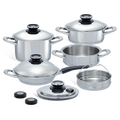
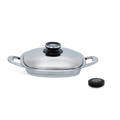
A by AMC, an uncoated stainless option
A by AMC is built entirely around that uncoated approach. It is a premium cookware brand pairing Swiss precision with Italian craftsmanship, with more than 60 years of engineering and a family heritage stretching back over 180 years.
Every pot and pan is made entirely from 18/10 stainless steel, manufactured without non-stick coatings or toxic chemicals that could contaminate food, and free from PFAS, PFOA, and PTFE. That makes it genuinely PFAS-free cookware, and one of the healthiest cookware choices you can make, precisely because there is no coating on the surface to chip or flake into food as the years pass.
A few things set A by AMC cookware apart:
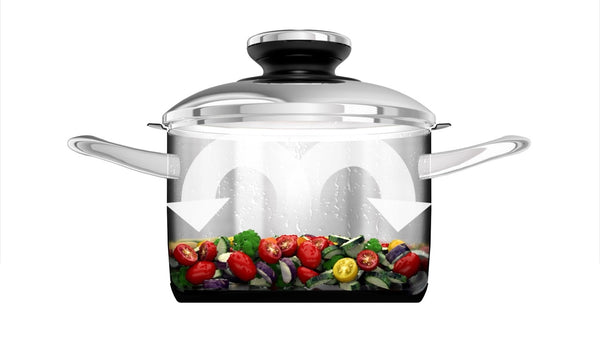
- A thick multi-layer base called Akkutherm spreads heat evenly and holds it steady, and heat-isolating Thermobloc handles stay cool on the stove.
- A built-in sensor reads the temperature inside the pot and shows a cooking zone on the lid, so you can see the moment a stainless pan is hot enough to sear rather than guessing at it. Our guide to the A by AMC cooking system covers the details of the sensor-led ecosystem.
- A 30-year warranty on the stainless steel body backs the durability that keeps an uncoated pan safe for decades.
You can browse the full range of A by AMC stainless steel cookware, and if you are weighing what cookware is worth over the long run, our guide to how much to spend on cookware works through the math.
Frequently Asked Questions
Is stainless steel cookware safe?
Yes. 18/10 stainless steel has no coating between the metal and your food and nothing to break down over time. Its chromium and nickel are blended into the alloy rather than sitting on the surface, so only tiny amounts ever transfer, mostly from brand-new pans, and that drops off as the pan breaks in. The amounts are small next to the nickel most people already get from food each day.
Is ceramic cookware safe?
Ceramic is PFAS-free and PTFE-free, a real advantage over traditional non-stick. Most ceramic pans are an aluminum body with a thin sol-gel coating, and that coating usually wears within one to three years. It is safe while the coating is intact. Once it wears through, food starts cooking on the aluminum underneath.
Is non-stick cookware safe?
At low to medium heat with the coating intact, modern non-stick is safe to cook on. The two things to watch are heat and wear. Overheating an empty pan can release fumes that cause a temporary, flu-like illness and are especially dangerous to pet birds. Flaking is about lifespan more than safety, and means the pan is worn out and due for replacement.
Is aluminum cookware safe?
Sealed or anodized aluminum is considered safe, because anodizing hardens the surface so it does not react with food. Bare aluminum is reactive and can leach into acidic dishes. Most people never buy a bare aluminum pan on purpose, but a non-stick or ceramic coating that has worn away leaves the aluminum body exposed, and from then on food is cooking directly on that metal.
What is the safest cookware material?
For most home cooks, uncoated 18/10 stainless steel is the safest all-round choice, with no coating to break down and nothing to flake into food as it ages. Cast iron and carbon steel are also safe uncoated options, each with their own trade-offs. What the safest options share is simple, none rely on a coating that can wear out and fail.
Cook. Respond. Succeed.
A new way of cooking. Built to last. Made to repeat.
Explore the A by AMC active cookware line and find the ecosystem built for the way you cook.