



Buying Guides
A by AMC vs. All-Clad: Full System Comparison for Serious Home Cooks
A by AMC and All-Clad offer premium 18/10 stainless steel cookware that will outlast the kitchen it sits in. The real difference is what happens while you cook.

All-Clad and A by AMC both make premium stainless steel cookware. Both will last decades. Both cost more than the cookware people end up replacing every few years. And on the metal itself, there is very little difference between them.
All-Clad has been bonding cookware in Canonsburg, Pennsylvania since 1971. A metallurgist founded the company, and the product line follows from a single idea: get the metal right, and a good cook handles the rest. Heat, timing and technique are left to you.
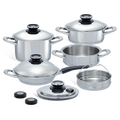
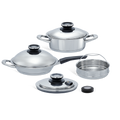
A by AMC works from the same premium 18/10 stainless steel, with more than 60 years of Swiss engineering behind it, a family heritage that runs back over 180 years, and Italian craftsmanship in the design. What is different sits in the lid. Sensors read the heat inside the pot and show you the cooking zone as you go, and a separate device connected to the lid even signals the moment to act.
The choice is not really about steel. It is about whether you want premium cookware that performs, or premium intelligent cookware that performs and tells you what it is doing while you cook.
A by AMC vs. All-Clad: Materials and Construction

Before getting into what separates these two, it helps to know how much they have in common. On materials and construction, that turns out to be a lot.
Both start with 18/10 stainless steel
18/10 is the grade most premium stainless cookware is made from. Roughly 18 percent chromium, which resists corrosion and keeps the metal from reacting with acidic food, and roughly 10 percent nickel for strength. Nothing is coated on top. The steel is the cooking surface, which is why a scratch is a cosmetic mark rather than a failure.
All-Clad states that its D3 construction uses an 18/10 stainless interior. Every A by AMC pot and pan is built on 18/10 stainless too, with no non-stick layer and no PFAS, PFOA or PTFE. In both cases, you are cooking directly on bare stainless steel and nothing else.
What tri-ply and clad construction actually mean
Clad cookware means layers of different metals bonded together under heat and pressure, so a conductive core sits between durable stainless faces. The process was already being used in industry, for coinage and aircraft parts, before it ever reached a kitchen.
What is tri-ply stainless steel? Three bonded layers. All-Clad's D3 line is tri-ply cookware, an aluminum core between two layers of stainless, bonded from base to rim. The D5 line is 5-ply cookware, alternating five layers for extra resistance to warping. Other brands sell 3-ply cookware and multi-ply cookware on the same principle, where more layers generally mean more mass rather than a different kind of performance.
All-Clad's bonded stainless collections are made in the USA with global components, at the Canonsburg factory. Do chefs use All-Clad? Yes, and have for decades.
How A by AMC builds its base instead
Most cookware is built one of two ways. Fully clad, where the metal layers run all the way up the walls, which is what All-Clad makes. Or disc bottom cookware, where a separate plate of conductive metal is attached to the underside of a thinner steel pot. A by AMC is neither.
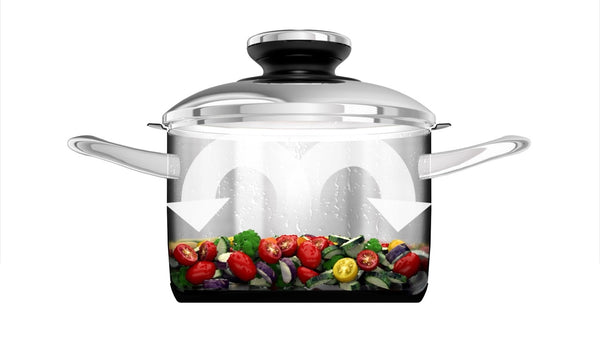
Its base is a multi-layer capsule, pressure-welded rather than attached, which makes it encapsulated base cookware. A by AMC calls it Akkutherm. It takes heat in quickly, spreads it so there are no hot spots or cold spots, and stores residual heat instead of letting it escape. That stored heat is what makes cooking with very little water or oil work, and it lets you finish cooking on a low setting or none at all, which saves energy. Where the handles meet the pot, a ceramic heat stopper called Thermobloc blocks that heat from traveling out along them, so the base can run hot while the handles stay cool enough to grab.
The result is that heat behaves differently in each. All-Clad's aluminum core carries it up the walls, bringing the sides of the pan into the cooking. A by AMC's base takes it in and holds onto it, which is what a closed pot is designed around. Both work well. They are built for different ways of cooking.
Everyday compatibility
Both work on any stovetop, including induction. All-Clad is oven and broiler safe to 600°F. A by AMC cookware is fully ovenproof once the Visiotherm and Audiotherm are taken off, and the frying pan handle detaches so the pan can go in the oven without it. Cleaning is where they part: All-Clad recommends hand washing, while A by AMC pots and pans are dishwasher safe.
| All-Clad | A by AMC | |
|---|---|---|
| Cooking surface | 18/10 stainless steel, no coating | 18/10 stainless steel, no coating |
| Construction | Fully bonded clad, tri-ply (D3) or five-ply (D5), layers run base to rim | Pressure-welded multi-layer capsule base (Akkutherm), heat stored at the base |
| Handles | Riveted stainless steel handles | Ergonomic handles with a ceramic heat stopper (Thermobloc) that stay cool; the frying pan handle detaches |
| Made in | Bonded stainless collections made in the USA with global components, in Canonsburg, Pennsylvania since 1971 | Swiss precision and Italian craftsmanship, with 60+ years of engineering behind the system |
| Stovetops | All, including induction | All, including induction |
| Oven | Oven and broiler safe to 600°F | Fully ovenproof once the Visiotherm and Audiotherm as well as the detachable frying pan handle are taken off |
| Cleaning | Hand washing recommended | Dishwasher safe |
| Temperature feedback | None. Heat is judged by eye and experience | Sensotherm reads the heat inside the pot, the Visiotherm shows the cooking zone on the lid, and the Audiotherm signals when to act |
| Guided cooking | None | Step-by-step guidance through the Cook & Go App |
| Sold as | Individual pieces and sets | Individual pieces and complete collections, from a 7-piece core set up to a 15-piece system |
A by AMC vs. All-Clad: What Happens While You Cook

If the metal is a draw, what actually separates these two? Everything that happens after you turn the burner on.
The problem with preheating a stainless steel pan
Look up how to preheat stainless steel pan and the advice is consistent, including in All-Clad's own care instructions. Heat the empty pan, flick in a few drops of water, and watch. If the droplets skitter and bead across the surface, the pan is ready. If they hiss and vanish on contact, the pan is too hot, and you start again.
The technique works, and cooks have used it for generations. But it is a workaround for a number nobody can see. Searing in stainless steel is not difficult because the metal is temperamental. It is difficult because the temperature is hidden and you end up reading water droplets instead. Guessing. Checking. Losing heat every time we lift the lid to look.
Seeing the cooking zone instead of guessing at it
A by AMC puts the sensor in the lid. It is called Sensotherm, and it reads the temperature inside the pot while the lid stays closed. The Visiotherm, the display built into the lid knob, turns that reading into a cooking zone you can see in real time.
There are separate zones for roasting, cooking and steaming. When the indicator reaches the roasting zone, that is your signal to add the steak. When it exceeds the vegetable zone, that is your signal to bring the heat down. Either way you are not lifting the lid to find out, because the lid, the Audiotherm or the app has already told you.
Hearing the moment to act
Sight is half of it. Timing is the other half, and that is the Audiotherm. It clicks onto the Visiotherm, displays the actual temperature zone inside the pot, and sounds a signal at each stage when something needs doing. Set a cooking time and the countdown does not begin until the pot has reached the appropriate temperature zone for the selected cooking method, a small detail that quietly solves a lot of undercooked dinners.
That is also what lets you walk away from the stove. The Audiotherm will call you back when the pan is ready to sear, when it is time to flip, and when the heat needs to come up or down. It also connects by Bluetooth to the Cook & Go App, which walks you through recipes step by step. For the full detail on how the cookware works, our guide to the A by AMC cooking system covers all of it.
Why cooking gets easier the more you use A by AMC
This is the part that matters more than any single feature. When the display tells you the pan has reached the roasting zone and the steak should go in now, you start to learn what that moment looks like, sounds like and smells like. The signals stop being someone else's instructions and turn into your own judgment.
Cook a dish once with the guidance and you have a good dinner. Cook it five times and you own it. That is the real argument for smart cookware, and it is not automation. Nothing here cooks for you. It stops asking you to guess, and a cook who is not guessing improves faster and becomes more efficient and relaxed.
All-Clad gives you excellent metal and leaves the learning to trial and error. A by AMC gives you the same quality of steel and tells you what it is doing, so you stay in control of the heat and the timing rather than guessing That is the whole difference.
A by AMC vs. All-Clad: Price and Long-Term Value
Here is what each one costs, and why that number matters less than how long it lasts.

What each one costs
All-Clad sells individual pieces and full sets, with its flagship stainless sets running into several hundred dollars. A by AMC sells both as well, from a seven-piece core set up to a fifteen-piece system, so a first-time owner can cover every cooking method from the start rather than building up over years.
Current pricing and the contents of each set are listed across the A by AMC cooking systems, and there are savings for buying a complete set rather than piece by piece.
Why you only buy it once
Is premium cookware worth it? Add up what you spend replacing a cheap set every few years and the answer usually sorts itself out. Neither A by AMC nor All-Clad has a coating, which matters more than it sounds. A non-stick surface is a consumable. It wears, it scratches, and when it goes the pan goes with it. Bare stainless has nothing to lose, which is why cookware that lasts a lifetime is almost always uncoated.
A by AMC backs the stainless steel body of its cookware with a 30-year warranty. Both brands stand behind their cookware and the terms differ, so they are worth reading before you buy. If you want the numbers on whether premium pays off over time, our guide to how much you should spend on cookware works through it.
It is not just A by AMC saying so, either. The Cook & Go App took a Kitchen Innovation Award in 2023, and the full cooking system won the same award in 2021, along with a Best of the Best distinction in the Small Electrical Appliances category.
When All-Clad is the right call
Is All-Clad worth it? For the right cook, yes. If you already read a pan by eye, if the water droplet test is second nature, and you want bonded metal with nothing attached to the lid, All-Clad does exactly that, and it belongs on any list of the best stainless steel cookware brands. Nothing here is an argument against it. If you are still working out what matters most in cookware at this level, our premium cookware buying guide goes through it properly.
Frequently Asked Questions
Is A by AMC better than All-Clad?
A by AMC does something All-Clad does not. It reads the temperature inside the pot, shows the cooking zone on the lid, and signals the moment to act, so heat and timing stop being guesswork. All-Clad has no equivalent to that. On construction and materials the two are close, both 18/10 stainless with no coating, both lasting for decades. It comes down to what you want out of cookware. If you want it to tell you what is happening inside, only one of these two does.
Can A by AMC replace my All-Clad cookware?
Yes, and you would not lose anything on the metal. Both are 18/10 stainless with no coating, so anything you cook in an All-Clad pan works the same way in an A by AMC one. What changes is the information. The lid tells you when the pan is ready to sear and when to bring the heat down, so the technique you built up on All-Clad still applies. You are no longer guessing. A by AMC sells individual pieces as well as full sets, so you can start with one pot rather than replacing everything at once.
Which premium stainless steel cookware gives you the most precise temperature control?
Precise temperature control needs two things. The metal has to hold heat steadily, and you have to know what the temperature actually is. Most premium stainless cookware, All-Clad included, does the first well and leaves the second to the cook's eye or a separate thermometer. A by AMC is the exception, because the measurement is part of the cookware. A sensor called Sensotherm reads the temperature inside the pot, the Visiotherm display in the lid knob shows the cooking zone in real time, and the Audiotherm displays the actual temperature zone and signals at each stage.
Cook. Respond. Succeed.
A new way of cooking. Built to last. Made to repeat.
Explore the A by AMC active cookware line and find the ecosystem built for the way you cook.