



Smart Cookware
Smart Cookware vs. Smart Kitchen Appliances: Which Actually Belongs in Your Kitchen?
Smart kitchen appliances and smart cookware are not the same thing. Here is what each one does, what each one gives up, and how to decide which belongs in your kitchen.

The term "smart" gets applied to all kinds of kitchen products: smart kitchen appliances like cooking robots, pressure cookers, and countertop ovens, and smart cookware like sensor-enabled and app connected stovetop pans. They are not doing the same job and they are not built the same way.
Below is an honest comparison of both: what smart cooking appliances do well, what smart cookware does differently, and how to figure out which one is best for your kitchen.
What Are Smart Kitchen Appliances?
The term covers more ground than most people realize. Cooking robots, multi-cookers, and smart countertop ovens all fall under the same label, but they work differently and are built for different kinds of cooks. Here is what each one actually is.
Cooking Robots
A cooking robot is a sealed countertop unit that chops, blends, steams, sautés, and slow-cooks inside one bowl. The Thermomix TM7 is the best-known example, priced at over $1,600, with a 10-inch touchscreen and access to over 100,000 guided recipes via the Cookidoo platform. You add ingredients when the machine prompts you, and it manages temperature, timing, and in some cases blade speed. Other cooking robots exist at lower price points, but the Thermomix remains the benchmark.
The appeal is real. A cooking robot handles prep that would otherwise take three different tools and 20 minutes of active effort. For anyone who wants to hand off that process entirely, it delivers.
Multi-Cookers
The most familiar name in this space is Instant Pot, which turned the sealed electric pressure cooker into a household staple. These countertop units pressure cook, slow cook, sauté, and steam inside a sealed vessel.
They are particularly good at the things that normally take the most time: turning a tough cut of meat tender, cooking dried beans from scratch, making stock, or getting a slow-cooked meal on the table on a weeknight. Some models connect via Wi-Fi with guided recipes through an app. You set it and come back when it is done. The unit lives on your counter or gets stored between uses.
Smart Countertop Ovens
Smart countertop ovens take several different approaches to guided cooking. The Brava cooks using six high-intensity lamps rather than traditional heating elements, which lets it cook multiple foods at different temperatures at the same time. June Oven has an internal camera that recognizes what you have placed inside and sets a cook program automatically. Tovala pairs with pre-portioned meal kits the oven scans and cooks to spec. Breville's Joule range connects to an app with guided recipes and voice control.
All three are designed around the same idea: the cook sets up the task, and the appliance takes it from there.
What Smart Cooking Appliances Do Well, and What They Give Up
These are genuinely useful products. The Thermomix TM7 turns a complex prep session into a guided sequence that runs itself. The Instant Pot cuts a three-hour braise down to about an hour, mostly unattended. A smart countertop oven gets dinner on the table without needing to watch it. For households that want reliable, home-cooked food without spending a lot of active time in the kitchen, these tools deliver on that promise.
The tradeoff is straightforward. When the appliance is making the decisions, the cook is not. That is the design, and for the right household it is exactly the point.
What you learn from using these tools is specific to the tool itself: which program to run, how the app works, what settings produce what results. Useful knowledge for that appliance. It does not make you a more confident cook the next time you are standing at a stove with a pan in hand.
For the cook who wants that active involvement back, smart kitchen appliances are not really the answer. They are built to take that off your plate, and they do it well. The question is whether handing off that process is what you actually want from cooking, or whether you want something that keeps you in it.
What Smart Cookware Does Differently
Smart kitchen appliances are built around one idea: handle the cooking so you do not have to. Smart cookware is built around a different one. The technology lives inside the cookware itself, used directly on your stove, and instead of replacing your decisions, it gives you the information to make better ones.
Imagine seeing the temperature zone inside your pot without lifting the lid. Imagine hearing a signal at the precise moment your pan is ready, calling you back to the stove whether you are in the next room or setting the table. That is not automation. That is the cookware telling you what is happening so you can act on it.
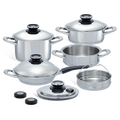
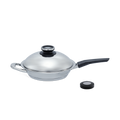
A by AMC is the active cookware line built on this idea. It is 18/10 stainless steel, free of PFAS, PFOA, and PTFE coatings, and engineered through 60 years of Swiss precision and 180 years of family heritage in cookware craft.
The metal is not what makes it different. Premium stainless steel brands use the same 18/10 grade. What sets it apart is a responsive sensor-led ecosystem built into the cookware itself, purpose-built for the stovetop rather than the countertop.

The Rhythm the System Teaches
Monitor. Respond. Repeat. The cookware monitors what is happening inside it. It signals when to act and guides what to do next. You respond and execute. The result becomes something repeatable, not because the machine did it, but because you did it with information you have never had access to before. After a few weeks that rhythm becomes instinct. It works on any stovetop, with any protein, across every method the stove supports.
The Five Components
Five components work as one ecosystem: two form the physical foundation, three make up the sensor and digital layer that make it responsive.
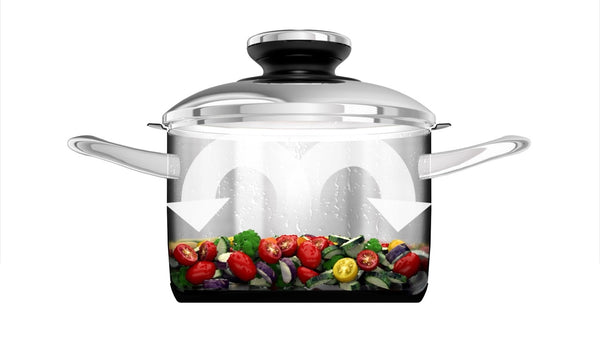
- Akkutherm: the multi-layer capsule base that absorbs and distributes heat evenly across the entire cooking surface, with no hot spots. This creates the stable, closed cooking environment that everything else in the system depends on. The handles use Thermobloc, a separate cool-touch handle technology, to stay cool while the base heats up.
- Sensotherm: a precision temperature sensor integrated inside the Visiotherm on the lid. It reads the actual temperature inside the cooking chamber, not the stove dial and not the exterior of the pan.
- Visiotherm: the temperature display built into the lid knob. It translates the Sensotherm reading into a visible cooking zone in real time, so you can see what is happening inside the pot without lifting the lid and releasing the heat and moisture locked in.
- Audiotherm: clips onto the Visiotherm, mirrors the cooking zone on its own display, tracks timing progress, and signals the precise moment to act. Connects via Bluetooth to the Cook & Go App so the alert reaches your phone if you have stepped away.
- Cook & Go App: the digital layer of the ecosystem. Guided recipes, step-by-step cooking cues, and timing prompts delivered through the Audiotherm connection. The app earned the Kitchen Innovation Award in 2023, following the full cooking system's recognition in 2021, which included a Best of the Best distinction in the Small Electrical Appliances category.
For a full breakdown of how all five components work together across every cooking method, see our complete guide to smart cookware.
For a closer look at each component in sequence, read how A by AMC's cooking system works.
Smart Kitchen Appliances vs. Active Cookware: A Direct Comparison

Both aim to remove the guesswork from cooking, but the design decisions behind each one are completely different. Here is how these smart cooking tools compare across the things that matter most to a home cook:
| Cooking Robot / Multi-Cooker | Smart Countertop Oven | A by AMC Active Cookware | |
|---|---|---|---|
| Where it cooks | Countertop, sealed vessel | Countertop, enclosed oven | Any home stovetop |
| Where the technology lives | Inside a standalone appliance | Inside a standalone appliance | Inside the cookware itself, plus connected Audiotherm and Cook & Go App |
| Cook's role | Add ingredients when prompted | Load tray, press start | Cook actively, respond to sensor signals |
| Method range | Limited to built-in functions | Limited to oven-based methods | Sear, fry, braise, steam, roast, slow cook, minimal water cooking |
| What gets better over time | Familiarity with that appliance | Familiarity with that appliance | The cook's skill, usable anywhere |
The difference comes down to involvement. Smart kitchen appliances handle the cooking for you. A by AMC keeps you in it, with real-time information that makes every decision more confident and every result more repeatable.
Which One Belongs in Your Kitchen?

The honest answer is that it depends on what you want out of cooking. If you want to hand a process to a machine and walk away, a smart kitchen appliance does that well. If you want to stay in the kitchen, cook on your own stove, and get consistently better results with every meal, that is a different tool entirely.
A multi-cooker makes sense for specific tasks: weeknight soups, pulled pork, pressure-cooked rice, larger batch chili. It is good at a defined set of jobs, and there is nothing wrong with owning one for exactly that purpose.
A by AMC is for everything on your stove. It works on the stovetop you already have, on gas, electric, ceramic, or induction. The sensor feedback works across every method and every ingredient. And the stainless steel body carries a 30-year warranty, so it is one purchase rather than a replacement cycle.
Starting Out: The Essential Collection
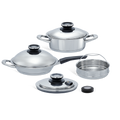
The Essential Collection is where most first-time A by AMC owners begin. It covers searing, frying, braising, and steaming, with one Audiotherm included.
Explore the Essential Collection.
Cooking for More: The Foundation Collection
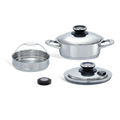
The Foundation Collection is built for households cooking for four or more on a regular basis. It adds a Stock Pot for soups, stews, and batch cooking, a Combi Steaming Stackable for multi-layer steaming, and a second Audiotherm.
Explore the Foundation Collection.
Not sure which fits how you cook? Take our quiz for a personalized recommendation.
Frequently Asked Questions
Is A by AMC the same as an Instant Pot?
No. An Instant Pot is a sealed countertop appliance that manages a cooking process inside a closed vessel. You set a program and step away. A by AMC is stovetop cookware with sensor technology built into the pots and lids. You cook on your own stove, respond to real-time feedback, and stay in control of every decision.
Can A by AMC replace a Thermomix?
They are built for different things. A Thermomix handles batch prep and guided cooking inside a sealed countertop unit. A by AMC covers everything on your stove: searing, frying, braising, steaming, roasting, and minimal water cooking, with sensor feedback at every step. Some households own both. They do not compete for the same job.
Is A by AMC difficult to learn?
No. The system is designed to remove guesswork, not add complexity. The Visiotherm shows you the temperature zone inside the pan in real time. The Audiotherm tells you when to act. The Cook & Go App walks you through recipes step by step. Most cooks find their footing within the first few uses. The more you cook with it, the more the rhythm becomes second nature.
Cook. Respond. Succeed.
A new way of cooking. Built to last. Made to repeat.
Explore the A by AMC active cookware line and find the ecosystem built for the way you cook.